
Muscle relaxers are prescription medications for muscle spasms, stiffness, and the pain that comes with them. You probably know a few by name: Flexeril, Soma, Robaxin, baclofen. They get lumped together, but they work differently and they don’t carry the same risks.
They also show up in medical detox. Opioid withdrawal makes your whole body ache, cramp, and clench, and a muscle relaxer is one of the tools a medical team can use to take the edge off that. At Liberty Health Services, the one we use in certain detox protocols is baclofen.
This guide covers what muscle relaxers are, why withdrawal hurts the way it does, how baclofen fits into detox here, and the part people are often afraid to ask about: whether these medications can be misused or cause dependence themselves.
If you’re in New Hampshire and you’re in withdrawal right now, call Liberty Health Services at 855.959.4521. Admissions is available around the clock.
What are muscle relaxers?
Muscle relaxers, also called skeletal muscle relaxants, are medications that reduce muscle spasms or muscle spasticity. Those are two different problems. A spasm is a muscle that seizes up after a strain or injury. Spasticity is ongoing tightness caused by a nerve condition like multiple sclerosis or a spinal cord injury.
Doctors prescribe them for:
- Back and neck pain with muscle spasms
- Muscle strains and some injuries
- Painful muscle tightness
- Spasticity from neurological conditions
- Muscle discomfort during withdrawal, in some cases
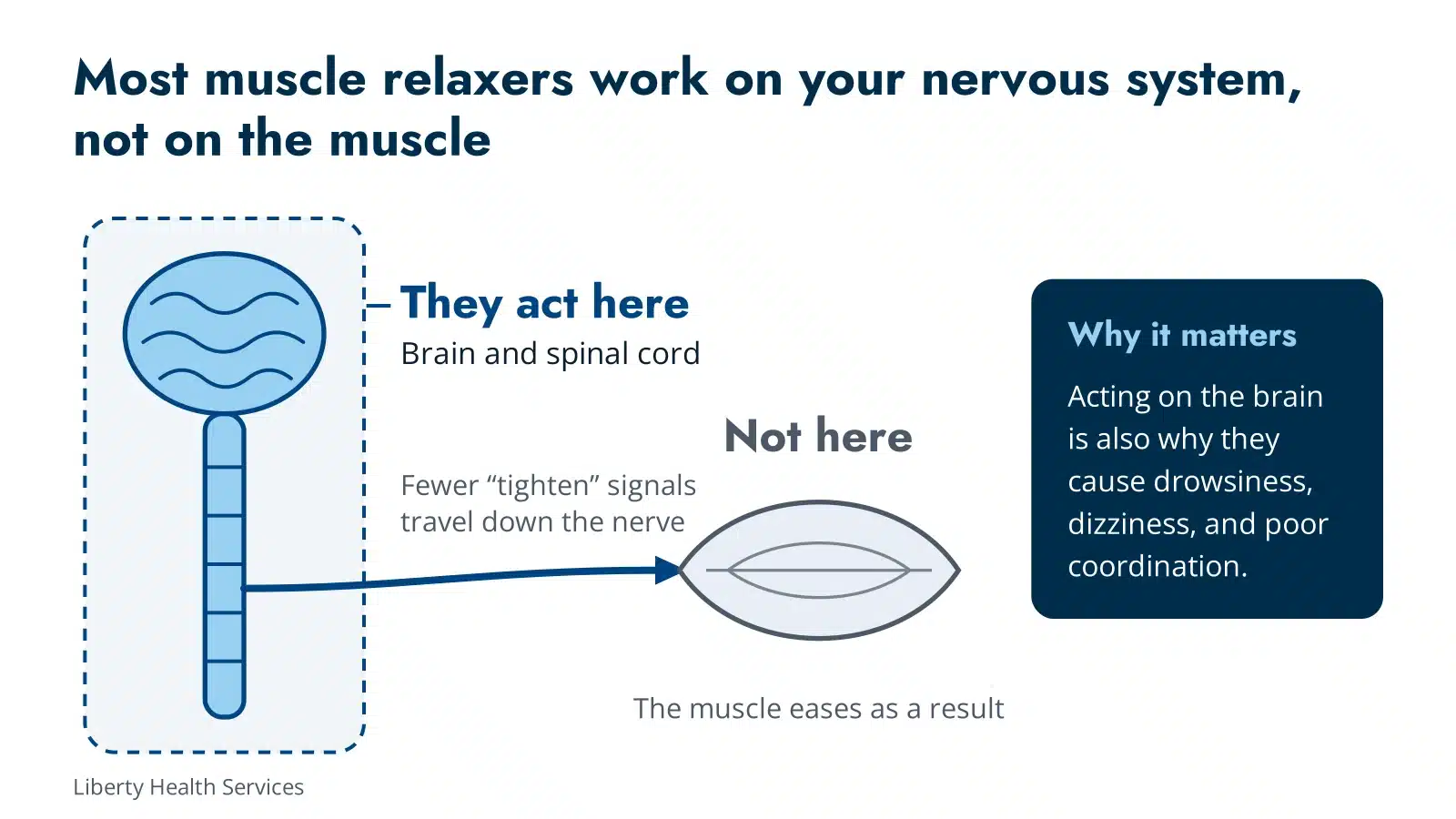
Here is the part most people don’t realize: most muscle relaxers don’t act on the muscle at all. They act on your brain and spinal cord, which is why the common side effects are drowsiness, dizziness, weakness, and poor coordination. It is also why they get risky when mixed with anything else that slows you down.
Some are meant for a few days after an injury. Others are taken long term for chronic spasticity. Which one you were given matters.
What are the most common muscle relaxers?
Six muscle relaxers account for most prescriptions in the United States.
| Generic name | Brand name you may know | Typical use | Federally controlled? |
|---|---|---|---|
| Cyclobenzaprine | Flexeril, Amrix | Short-term muscle spasms and strains | No |
| Methocarbamol | Robaxin | Painful muscle and joint conditions | No |
| Baclofen | Lioresal, Ozobax | Muscle spasticity and tightness | No |
| Tizanidine | Zanaflex | Muscle spasticity | No |
| Carisoprodol | Soma | Short-term painful muscle conditions | Yes, Schedule IV |
| Metaxalone | Skelaxin | Muscle and joint discomfort | No |
Soma is the outlier. It is a federally controlled substance with a well-documented history of misuse and dependence. The others are not controlled, but “not controlled” is not the same as “no risk.” Baclofen in particular can cause physical dependence and a serious withdrawal reaction if it is stopped suddenly. More on that below.
What do muscle relaxers look like?
There is no one look. Most muscle relaxers are small white or off-white tablets, which is exactly why they get mixed up with each other and with other medications. A few stand out by color: some cyclobenzaprine is yellow, some methocarbamol is orange, and metaxalone is usually pink.
Color and shape will not tell you what a pill is. The imprint will. Every prescription tablet or capsule sold in the United States is stamped with letters or numbers that identify the drug, the strength, and the company that made it. Here are some of the common versions, taken from the manufacturers’ FDA labels on DailyMed.
| Medication | What it can look like |
|---|---|
| Baclofen | 10 mg: white round tablet stamped “N029,” white round tablet stamped “B” and “10,” or off-white oval tablet stamped “2265” and “V.” 20 mg: white round tablet stamped “N030” or “B” and “20.” |
| Cyclobenzaprine (Flexeril) | 10 mg: yellow round tablet stamped “IG” and “283.” 5 mg: beige round tablet stamped “IG” and “282.” Amrix, the extended-release brand, is an orange capsule (15 mg) or a red capsule (30 mg). |
| Methocarbamol (Robaxin) | 500 mg: white round tablet stamped “S” and “225,” or orange round tablet stamped “G” and “500.” 750 mg: white capsule-shaped tablet stamped “S226,” or orange capsule-shaped tablet stamped “G” and “750.” These are large tablets. |
| Tizanidine (Zanaflex) | 4 mg: white oval tablet stamped “R” and “180,” or white round tablet stamped “APO” and “TI 4.” 2 mg: white oval tablet stamped “R” and “179.” Brand-name Zanaflex capsules are blue. |
| Carisoprodol (Soma) | Brand-name Soma is a white round tablet stamped “SOMA 350” or “SOMA 250.” Generic 350 mg versions are also white and round, stamped “SG” and “109” or “D” and “31.” |
| Metaxalone (Skelaxin) | 800 mg: pink oval or capsule-shaped tablet. Brand-name Skelaxin is stamped “8667” and “S.” Generics include “AN” and “553” or “LCI” and “1435.” |
This is a sample. Dozens of companies make these medications, each with its own imprint, and the pill in your bottle can change from one refill to the next when the pharmacy switches suppliers. If the imprint on your pill is not listed here, that does not mean something is wrong.
If you have a pill you cannot identify, ask a pharmacist or call Poison Control at 1-800-222-1222. And if a pill did not come from a pharmacy, the way it looks proves nothing. Counterfeit pressed pills are made to match the real thing, stamp and all, and can contain fentanyl.
Why do your muscles hurt during drug withdrawal?
Because your nervous system is rebounding. When you use opioids regularly, your body adapts to having them there. Take them away and everything the drug was holding down comes back louder, including pain.
People in opioid withdrawal rarely describe one sore muscle. They describe a deep, flu-like ache through the back, arms, and legs. Legs that won’t stay still. Muscles that twitch or stay clenched no matter what position you try. A body that will not relax long enough to sleep.
It usually arrives alongside sweating, chills, nausea, and restlessness, which makes all of it harder to ride out. How bad it gets and how long it lasts depends on the substance, how long you have been using, and your overall health.
We go deeper on this in our guide to back pain during drug withdrawal. If alcohol is the substance, the causes are different, and muscle pain during alcohol detox has its own guide.
Why are muscle relaxers used during medical detox?
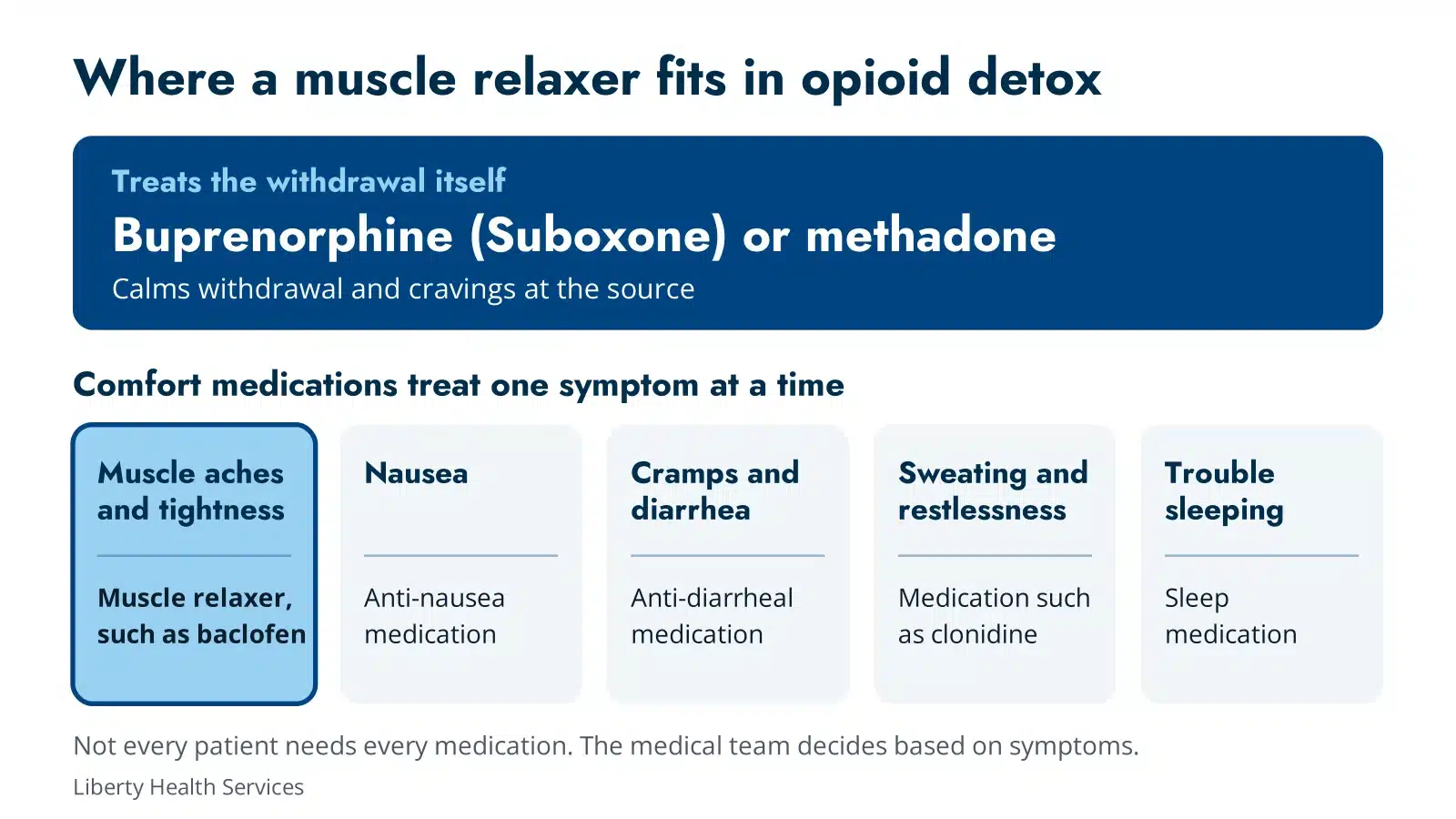
Detox is not just getting a substance out of your system. It is treating what your body does while that happens. Depending on the substance and your symptoms, a medical team may use separate medications for nausea, diarrhea, sleep, anxiety, and muscle pain. These are often called comfort medications.
Muscle relaxers are one of them. When tightness, cramping, or spasms are a big part of what you are feeling, relaxing the muscle can make the difference between lying awake all night and getting some rest. The Indian Health Service’s opioid withdrawal guidance for clinicians lists cyclobenzaprine and baclofen as options for muscle spasms, and methocarbamol is used the same way in many programs.
Two things are worth saying plainly. These medications are not interchangeable, and they are not right for everyone. And a comfort medication treats a symptom. It does not treat the withdrawal itself or the opioid use disorder underneath it. That is a different set of medications, and it is the core of what happens in drug detox.
How does Liberty Health Services use baclofen during detox?
Baclofen works by activating GABA-B receptors in the brain and spinal cord, which quiets the nerve signals that keep muscles firing. It is FDA-approved for spasticity from conditions like multiple sclerosis and spinal cord injuries. Using it for withdrawal symptoms is an off-label use, meaning a clinician prescribes it because the likely benefit outweighs the risk for that patient.
At Liberty Health Services, baclofen is part of certain medical detox protocols. We use it to help with the muscle soreness, aching, and tightness that come with withdrawal.
Withdrawal can leave you miserable even when there is no obvious spasm. Your muscles just feel tense and sore, and you cannot get comfortable enough to rest. Easing that tension can take away a real piece of the discomfort.
Baclofen is not a painkiller. It helps with the muscle-driven part of withdrawal pain, and it will not touch every ache.
Not every patient at Liberty gets baclofen. Our medical team decides based on your symptoms, your medical history, and what else you are taking.
Does baclofen stop withdrawal?
No. Baclofen manages a symptom. It does not stop withdrawal, and it does not replace the treatments that do.
For opioids, that means buprenorphine or methadone, which treat the withdrawal at its source and are the foundation of medication-assisted treatment. Our pages on opioid withdrawal management, Suboxone treatment, and methadone treatment cover how that works.
For alcohol and benzodiazepines, the stakes are higher. Those withdrawals can cause seizures, and a muscle relaxer is not a substitute for the medications that prevent them. If that is what you are coming off, read about alcohol detox, benzodiazepine detox, and the medications used in alcohol withdrawal.
Can muscle relaxers be abused?
Yes. The risk is very different from one medication to the next.
Soma (carisoprodol) is the clearest example. It is sedating, your body converts part of it into meprobamate, an older tranquilizer, and the DEA placed it in Schedule IV in 2012 because of how often it was being misused.
Baclofen, cyclobenzaprine, and methocarbamol are not controlled substances. People misuse them anyway. Prescription misuse usually looks like one of these:
- Taking more than prescribed
- Taking someone else’s prescription
- Taking them for the sedated or “loose” feeling rather than for a muscle problem
- Mixing them with alcohol, opioids, or benzodiazepines to make the effect stronger
- Continuing to use them even though they are causing problems
The mixing is where people get hurt. Muscle relaxers slow the central nervous system. So do alcohol, opioids, and benzodiazepines. Stack them and you can end up heavily sedated, barely conscious, or not breathing well enough. If someone cannot be woken up or their breathing is slow or shallow, call 911.
This matters most for people who already use other substances, because that is exactly who is likely to be taking more than one sedating thing at once.
Can muscle relaxers get you high?
Some can. Soma is known for producing a relaxed, euphoric feeling, especially at higher doses or combined with other drugs. Others mostly make people very drowsy, dizzy, or confused rather than high.
Taking extra to chase the feeling is how people end up in the emergency room. And to be fair to anyone taking these as prescribed: feeling sleepy after a muscle relaxer is a normal side effect. It does not mean you have a problem.
Can you become dependent on baclofen or other muscle relaxers?
Yes, and it can happen even when you take them exactly as prescribed.
Physical dependence means your body has adapted to a medication, so stopping it suddenly causes withdrawal. That is not the same thing as addiction, which is compulsive use that continues despite the harm it is causing. You can be dependent without being addicted.
What happens if you suddenly stop taking baclofen?
Stopping baclofen abruptly after taking it regularly can cause real withdrawal, and it can be dangerous. According to the National Library of Medicine’s baclofen guide, symptoms include:
- Muscle stiffness or spasms that come back worse
- Confusion
- Hallucinations
- Fever
- Seizures
In severe cases, baclofen withdrawal can be life-threatening. This is why it is tapered and never just stopped.
Baclofen is not the only one. Soma can cause withdrawal after long-term use. Tizanidine can cause a rebound spike in blood pressure and heart rate if it is stopped too fast.
If you have been taking a muscle relaxer regularly, do not quit on your own. Talk to whoever prescribes it about a taper. If you have been taking more than prescribed, or taking it with other substances, that is a situation for medical supervision. Our prescription drug detox and prescription drug withdrawal management pages explain how that works here.
Why would a detox center use a medication that has dependence risks?
It is a fair question, and the honest answer is that almost every useful medication in detox has some risk attached. Risk does not mean a medication should never be used. It means someone qualified has to decide when, for whom, and for how long.
In detox, that decision accounts for what you have been using, what else you take, your medical conditions, how severe your withdrawal is, and how the medications interact. A drug that helps one person can be the wrong call for the next.
There is also a real difference between a medical team giving you a measured dose for a few days, watching how you respond, and stopping it safely, and someone taking the same medication on their own with no one watching. Same pill, completely different situation.
That is how baclofen is used at Liberty: as one piece of an individualized protocol, for a specific symptom, when our clinical team decides it fits.
How does medical detox treat withdrawal symptoms?
Withdrawal does not look the same on everyone. One person is flattened by muscle pain and restlessness. Another has nausea, sweating, blood pressure swings, or cannot sleep at all. Alcohol and benzodiazepine withdrawal can turn life-threatening and need specific medical management.
Medical detox means a clinical team is assessing your symptoms, watching how they change, and adjusting treatment as you go. At Liberty Health Services in Derry, New Hampshire, comfort medications, including baclofen for some patients, are used alongside the primary withdrawal treatment so you are both safe and as comfortable as we can make you.
Detox is the first step. After it, most people continue into residential treatment or one of our other addiction treatment programs, which is where the reasons behind the use get addressed.
Frequently asked questions about muscle relaxers and detox
Is baclofen used during opioid detox?
Yes, in some programs, including ours. Baclofen can be added to help with muscle symptoms during opioid detox. It does not replace buprenorphine, methadone, or other established treatment for opioid withdrawal and opioid use disorder.
Does baclofen help with body aches during withdrawal?
It can help with the part of the ache that comes from tight, overactive muscles. It is not a general painkiller, and some withdrawal body aches will not respond to it.
Is Flexeril the same as baclofen?
No. Cyclobenzaprine (Flexeril) and baclofen are different medications. Flexeril is usually prescribed short term for muscle spasms after a strain or injury. Baclofen is mainly used for spasticity from neurological conditions. They work differently and carry different risks.
Are muscle relaxers opioids?
No. Baclofen, cyclobenzaprine, methocarbamol, and carisoprodol are not opioids and work differently from opioid pain medication, though some can still cause heavy sedation or dependence. Tramadol sometimes gets mistaken for a muscle relaxer, but it is an opioid. Our article on the 355 U tramadol pill explains what it is.
Can you take muscle relaxers with Suboxone?
Only under a clinician’s direction. Suboxone (buprenorphine and naloxone) and muscle relaxers both slow the central nervous system, so together they can increase sedation and, with some combinations, slow your breathing. In detox the combination is dosed and monitored. On your own, it is a risk.
Is baclofen addictive?
Baclofen is not a controlled substance and does not have the addiction track record that Soma does. It can still be misused, and physical dependence does develop. Stopping it suddenly after regular use can cause serious withdrawal.
Do you have to take muscle relaxers during detox?
No. Plenty of patients never need one. It depends on the substance, your symptoms, and what the medical team finds when they assess you.
Can you detox from muscle relaxers?
Yes. Baclofen, tizanidine, and carisoprodol can all cause physical dependence and real withdrawal, so they should be tapered under medical guidance rather than stopped cold. If a muscle relaxer has become part of a bigger pattern, our prescription drug addiction treatment program is built for that.
Medical detox at Liberty Health Services
Muscle relaxers are useful medications with real limits. In detox, they can make withdrawal more bearable. They are not the treatment, and they come with risks of their own, which is why they belong in the hands of a medical team.
If you are thinking about detox and want to know what medications you would be given and why, ask us. You can call just to ask questions, with no commitment. Reach admissions at 855.959.4521 any time, or verify your insurance online.