
Suboxone is a film because buprenorphine, its main ingredient, barely works when you swallow it. The medication has to soak in through the lining of your mouth, so it was built to dissolve under the tongue from day one.
It was not always a film, though. When Suboxone first reached U.S. pharmacies it was a small orange tablet. The film most people know as “Suboxone strips” arrived eight years later, and the story of how one replaced the other involves child safety, patents, and a federal antitrust case.
If you or someone you love has been handed a prescription and wondered why it looks like a breath strip, this guide covers how the medication works, where the pill went, and how to take either form correctly.
What do Suboxone strips look like? (Yes, like a Listerine strip)
If you have never seen Suboxone before, the first reaction is usually some version of “that’s it?” You tear open a small foil pouch and find a thin orange rectangle that looks almost exactly like a breath strip.
The resemblance ends there. A few things surprise people the first time:
- It does not go on your tongue. A breath strip sits on top. Suboxone goes underneath, off to one side.
- It does not vanish in two seconds. It takes minutes, and you have to sit there and let it.
- It does not taste like mint. Most people describe it as bitter with a citrus edge. Nobody takes it for the flavor.
- It is not something to leave on the counter. It looks harmless, which is exactly why it has to be locked away from kids.
Feeling a little awkward the first few times is normal. So is getting it slightly wrong, which is what the “what if” section further down is for.
What is Suboxone?
Suboxone is a brand-name prescription medication that combines two drugs, buprenorphine and naloxone, in a 4-to-1 ratio. It is FDA-approved for opioid withdrawal management and for maintenance treatment of opioid use disorder. This is the short version. Our full guide, What Is Suboxone?, goes deeper.
Buprenorphine does the work. It is a partial opioid agonist, which means it attaches to the same receptors as heroin, fentanyl, or oxycodone but only partly activates them. That is enough to quiet withdrawal and cravings without the full effect of those drugs.
Naloxone is the same medication found in Narcan. In Suboxone it is there as a deterrent, which we explain below.
Many people first meet Suboxone during opioid detox, where it is one of several medications used to manage withdrawal. Some continue it afterward as part of longer-term Suboxone treatment.
Why does Suboxone go under the tongue instead of being swallowed?
A swallowed pill travels through the stomach and intestines and then straight to the liver before it reaches the rest of the body. Pharmacists call this the first-pass effect. For most medications it is a minor toll. For buprenorphine it is nearly total: most of a swallowed dose is destroyed in the gut and liver before it can do anything.
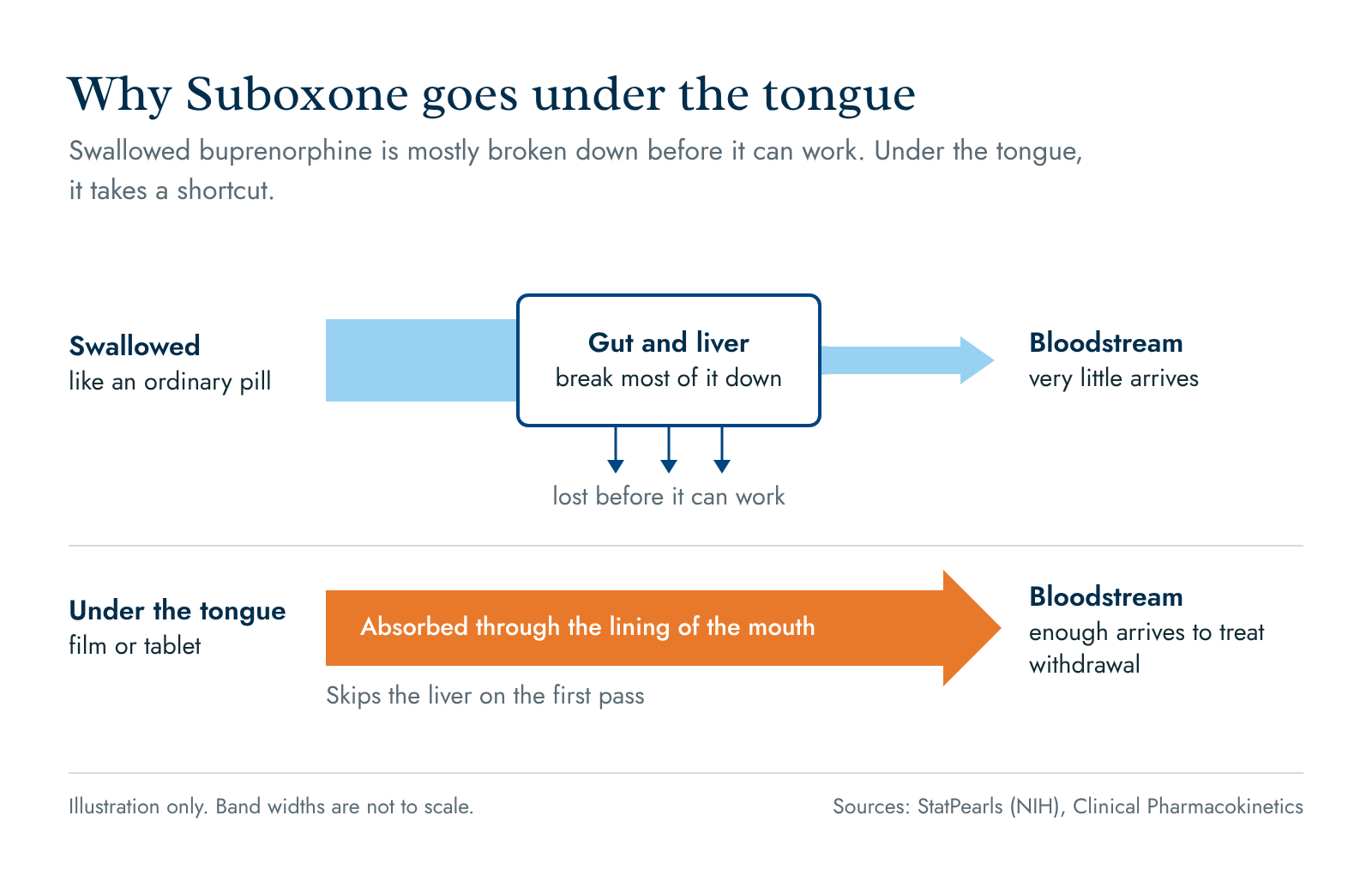
The tissue under your tongue is thin and full of small blood vessels. Medication that dissolves there passes directly into the bloodstream and skips the liver on the first trip. Pharmacokinetic research describes buprenorphine’s oral bioavailability as very low and its sublingual absorption as high enough to make that route practical for treatment.
This is why the directions say not to chew or swallow it. A dose that goes down your throat is mostly a wasted dose. That is true for the film and it was just as true for the original tablet. Both were always sublingual. The change in 2010 was the delivery vehicle, not the route.
Why is there naloxone in Suboxone?
Naloxone is in Suboxone to discourage injecting it. Under the tongue, naloxone is absorbed so poorly that it does almost nothing, so a person taking the medication as directed feels only the buprenorphine.
If someone dissolves the medication and injects it, the naloxone becomes active, blocks opioid receptors, and can trigger sudden withdrawal. The sublingual design and the naloxone work as a pair: one route delivers the treatment, and the other route is made unpleasant on purpose.
Did Suboxone used to be a pill?
Yes. Suboxone was sold in the United States as an under-the-tongue tablet for about a decade before the brand-name pill was pulled. Here is how it went from tablet to film.
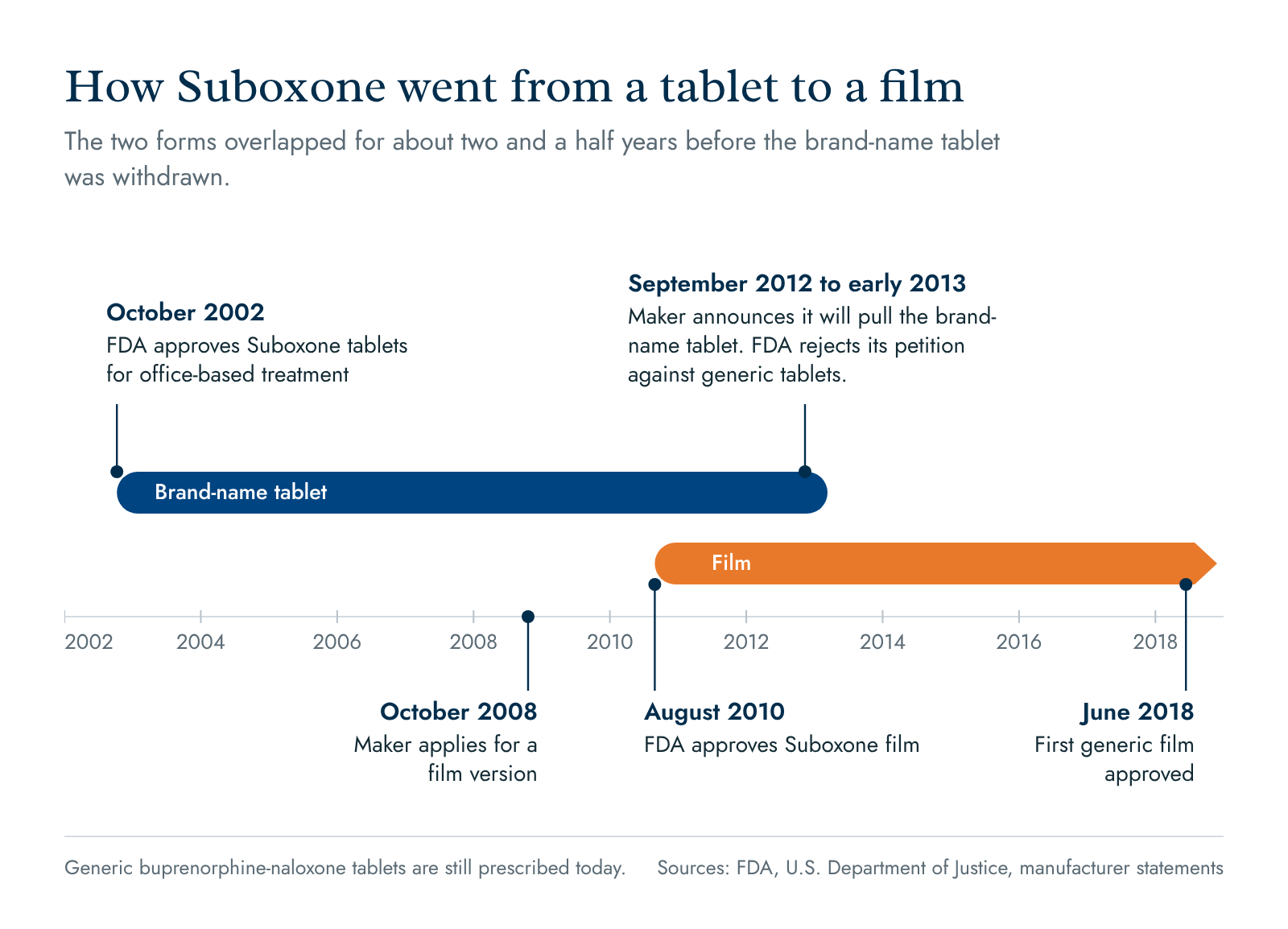
| When | What happened |
|---|---|
| October 2002 | The FDA approves Suboxone and Subutex sublingual tablets, the first buprenorphine products for opioid dependence. They could be prescribed from a doctor’s office instead of a methadone clinic. |
| October 2008 | The manufacturer, Reckitt Benckiser Pharmaceuticals (now Indivior), applies for approval of a film version. |
| August 2010 | The FDA approves Suboxone sublingual film in 2 mg and 8 mg strengths. |
| August 2012 | 4 mg and 12 mg film strengths are approved. |
| September 2012 | The company tells the FDA it will stop supplying brand-name Suboxone tablets within six months, citing accidental exposure in children. |
| February 2013 | The FDA denies the company’s petition asking it to hold generic tablets to new packaging rules. |
| June 2018 | The FDA approves the first generic versions of the film. |
So the pill did not vanish because it stopped working. The brand-name tablet was withdrawn by its maker, and generic tablets containing the same two ingredients are still prescribed today.
Why did Suboxone switch from tablets to film?
There are two versions of this story, and an honest answer includes both.
The company’s reason was child safety. In September 2012 the manufacturer said poison control data showed accidental exposure in children was 7.8 to 8.5 times more common with the tablets than with the film. It pointed to packaging as the likely cause. Tablets came loose in a 30-count bottle. Each film comes sealed in its own child-resistant pouch.
The company also described the film as a next-generation product, developed in response to reports of misuse, diversion, and accidental exposure involving the tablets.
Regulators saw a business reason. The tablet’s protection from generic competition was running out, while the film was covered by newer patents. The Federal Trade Commission later alleged the company ran a “product hopping” scheme, overstating the film’s safety advantage to move patients off tablets before cheaper generics arrived. Reckitt Benckiser settled those charges for $50 million in 2019. In 2021 the FTC mailed nearly $60 million in refunds to more than 51,000 people who had paid for the film.
None of that changes what the medication does. Film and tablet deliver the same two ingredients by the same route. The takeaway for patients is simpler: the format you are given often has more to do with insurance coverage and pharmacy supply than with one being medically better.
Suboxone strips vs. pills: what is the difference today?
Medically, very little. Both forms contain buprenorphine and naloxone, both dissolve in the mouth, and both treat the same condition. The differences are practical.
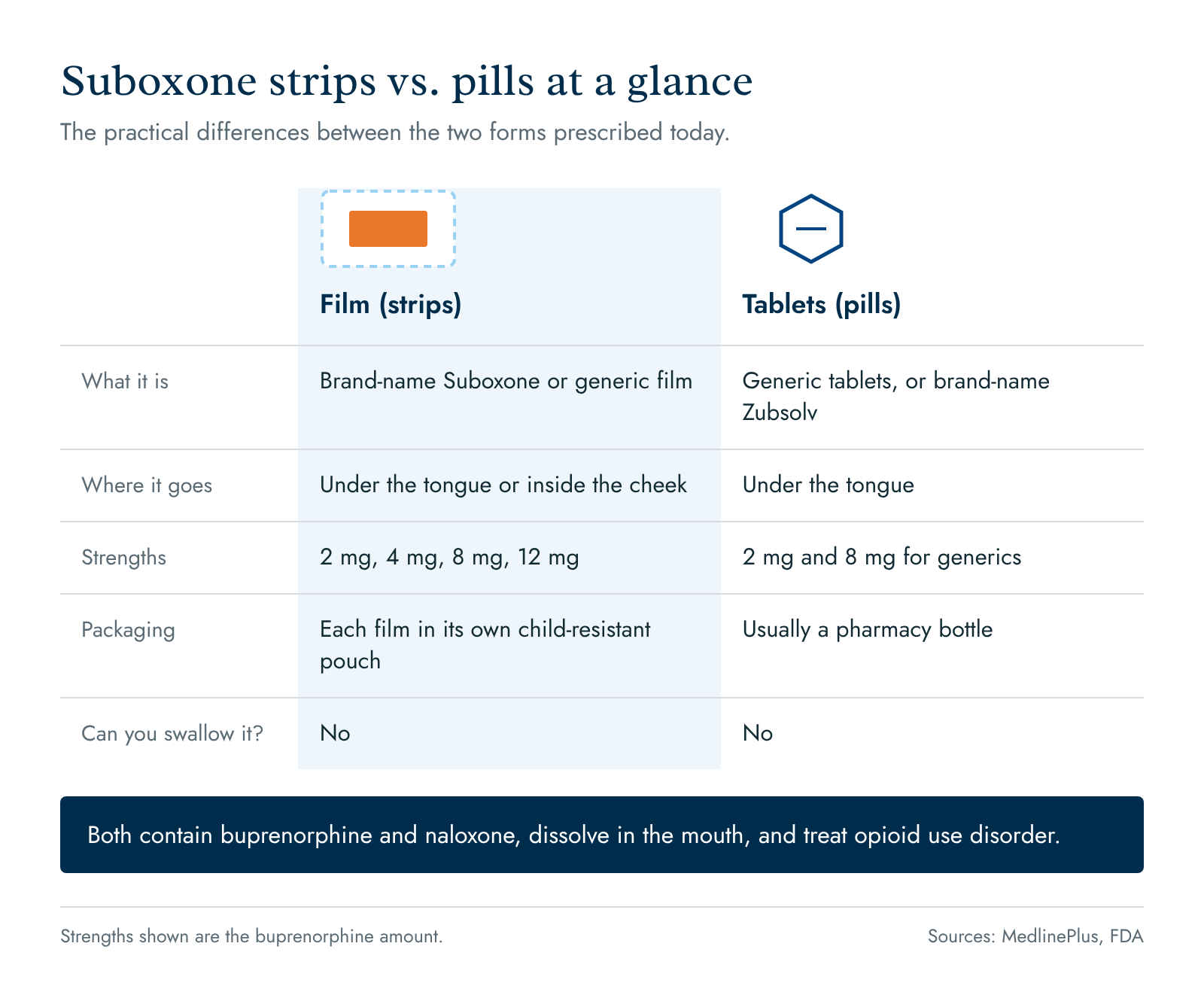
| Feature | Film (strips) | Tablets (pills) |
|---|---|---|
| What it is | Brand-name Suboxone or generic buprenorphine-naloxone film | Generic buprenorphine-naloxone tablets, or brand-name Zubsolv |
| Where it goes | Under the tongue or inside the cheek | Under the tongue |
| Strengths | 2 mg/0.5 mg, 4 mg/1 mg, 8 mg/2 mg, 12 mg/3 mg | 2 mg/0.5 mg and 8 mg/2 mg for generics |
| Packaging | Each film sealed in its own child-resistant pouch | Usually a pharmacy bottle |
| Can you swallow it? | No | No |
One caution: film and tablets are not always a perfect one-for-one swap. If your pharmacy or insurance changes your form, tell your prescriber so they can watch how you respond. Do not switch on your own.
Zubsolv vs. Suboxone
Zubsolv is a brand-name buprenorphine-naloxone sublingual tablet. It is designed to absorb more efficiently, so its doses use smaller numbers. A 5.7 mg/1.4 mg Zubsolv tablet is treated as equal to an 8 mg/2 mg Suboxone film. A lower number on the label does not mean a weaker dose.
Forms that skip the mouth entirely
Buprenorphine also comes as a long-acting injection given by a clinician, sold under names such as Sublocade and Brixadi. These are options for people who have trouble with a daily dose or with the dental effects described below. If you are weighing Suboxone against a different medication altogether, we compare them in Suboxone vs. Vivitrol and Suboxone vs. Methadone.
How to take Suboxone film the right way
Good technique matters, because anything that sends the medication down your throat lowers your dose. These steps follow the MedlinePlus patient instructions. Always follow your own prescriber’s directions first.
- Rinse your mouth with water or take a sip to moisten it.
- With dry fingers, place the film under your tongue, to the left or right of center.
- If you take two films, put the second on the opposite side. Do not let them overlap.
- Let the film dissolve completely. Do not chew it, swallow it, or move it around.
- Do not eat, drink, or talk until it is gone.
- Never cut or tear a film unless your prescriber has told you to.
Protect your teeth
In January 2022 the FDA warned about dental problems such as tooth decay and infections in people using buprenorphine that dissolves in the mouth. This applies to films and tablets alike. The FDA also said the benefits of the medication clearly outweigh this risk, so do not stop taking it over dental worries.
The agency’s advice is simple:
- After the film is fully dissolved, take a large sip of water, swish gently, and swallow.
- Wait at least one hour before brushing your teeth.
- See a dentist soon after starting, and tell them you take buprenorphine.
What if I took my Suboxone wrong?
Almost everyone does at some point, and one imperfect dose is rarely an emergency. Here is what each common slip actually means. For anything that worries you, your prescriber or pharmacist is the right call.
What if I swallowed it?
You will not be poisoned. You just will not get much out of that dose, because swallowed buprenorphine is mostly broken down before it reaches your bloodstream. You may notice the medication wearing off sooner than usual.
Do not take a second film to make up for it unless your prescriber tells you to. If withdrawal symptoms show up before your next dose, call them.
What if I swallowed my spit while it was dissolving?
Some of this is unavoidable, and it is fine. The goal is to keep the film in contact with the tissue under your tongue for as long as possible, not to hold perfectly still. Try not to swallow on purpose until the film is gone.
What if I brushed my teeth right after?
Once is not going to ruin your teeth. The FDA advises waiting at least an hour before brushing so your mouth can return to its natural state first. Going forward, swish with water and swallow after each dose, and save the toothbrush for later.
What if I talked, ate, or drank while it was dissolving?
Same outcome as swallowing, just smaller. Talking moves the film around, and food or drink washes medication down your throat. You probably absorbed less than a full dose. Do not re-dose on your own.
What if I put it on top of my tongue, like a breath strip?
It will still dissolve, but more of it gets swallowed and less gets absorbed. Next time, tuck it underneath.
What if it stuck to my fingers or tore?
Wet fingers are the usual culprit. Dry your hands before opening the pouch. If a piece is lost or the film falls apart, take what you can as directed and let your prescriber know. Do not open another pouch to make up the difference without asking.
What if I chewed it?
Chewing turns an under-the-tongue medication into a swallowed one. See above: weaker dose, no extra film, call if you feel withdrawal.
What if I took it and felt worse, fast?
This one is different, and it is worth a phone call right away. Feeling suddenly sick within an hour or so of a first dose can mean the medication was started too soon after another opioid. It comes up most often for people starting Suboxone after fentanyl. The next section explains why.
Starting Suboxone safely: why timing and supervision matter
The form matters less than how and when the first dose is given. Because buprenorphine grips opioid receptors tightly while only partly activating them, taking it too soon after another opioid can push that opioid off and bring on withdrawal fast. Clinicians call this precipitated withdrawal, and we cover the timing in what happens when you take Suboxone too soon. It is one of the main reasons people give up on the medication after a bad first try at home.
During medical detox, staff watch your withdrawal symptoms and time the first dose to them. At Liberty Health Detox in Derry, New Hampshire, both forms are in use. “Liberty Health uses the sublingual strips most of the time, but there are times when we will utilize the pill version in our detox,” says Emily Earle of Liberty Health. Timing can be harder to judge after fentanyl, which is one reason fentanyl withdrawal goes better with medical support. Liberty provides drug detox for opioids and ongoing opioid addiction treatment, part of the full range of substances we treat.
If you are trying to figure out whether Suboxone, detox, or both make sense for you or someone you love, our admissions team can talk it through at 855.959.4521.
Suboxone strips on Reddit: what the forums get right and wrong
A lot of people learn about Suboxone from Reddit and other forums before they ever talk to a prescriber. Some of what gets passed around is useful. Some of it is a sales pitch from 2012 that never died. Here are the claims that come up most.
“The film can’t be diverted or misused”
Not true, and pharmacists have been skeptical of this one for years. The film was marketed as harder to misuse than the tablet, but people who work behind the counter and people in recovery both say the same thing in these threads: any form of buprenorphine can be traded or sold. What the film does have is individual packaging. Every dose is sealed in its own pouch, which makes doses easier to count and keep track of. That is accountability, not a force field.
“It glues itself to your cheek”
Sort of. A film placed against a moist cheek or under the tongue does cling quickly, which is why you are told not to move it. It is still a dissolving strip, not an adhesive. It works because it stays put for a few minutes, not because it bonds.
“You’re supposed to be off it in six months”
This shows up constantly, sometimes from people who work in health care. There is no standard deadline. How long someone stays on Suboxone is a decision between that person and their prescriber, and many people do better staying on it longer rather than rushing a taper.
“The tablets work better than the strips”
Plenty of people swear by one form or the other, usually over taste or how fast it dissolves. Those preferences are real. A difference in how well the medication treats opioid use disorder is not. If one form bothers you, say so. Switching is a reasonable thing to ask for.
“The pharmacy is going to judge me”
This is the honest one. Stigma is real, and you can find pharmacy staff online saying unkind things about people on Suboxone. In the same threads you can find a pharmacy technician describing Suboxone patients as the easiest, most consistent customers they have. You can also find a skeptic changing their mind in real time after a pharmacist explains that the goal is stability, not punishment. Filling this prescription means you are doing the treatment. Nobody at the counter has earned the right to make you feel otherwise.
Frequently asked questions
Does Suboxone come in pill form?
Brand-name Suboxone tablets were discontinued in the United States after 2012, so brand-name Suboxone is now a film. The same medication is still available as generic buprenorphine-naloxone tablets and as the brand-name tablet Zubsolv.
Can you cut Suboxone strips in half?
Not on your own. The patient instructions say to take the film whole and not to cut or tear it. Some prescribers do direct partial films for specific dosing plans, so if you think you need a smaller dose, ask first and follow their instructions exactly.
How long does Suboxone take to dissolve?
A film usually dissolves within several minutes, and tablets often take somewhat longer. A dry mouth slows it down, which is why the instructions start with a sip of water.
What did the orange Suboxone pill look like?
The original brand-name Suboxone tablet was orange, six-sided, and lemon-lime flavored. It is no longer made for the U.S. market. Generic buprenorphine-naloxone tablets sold today vary in color, shape, and markings by manufacturer, so check the description on your pharmacy label. Never take a pill you cannot identify or that did not come from a pharmacy.
Are Suboxone strips stronger than the pills?
No. An 8 mg film and an 8 mg generic tablet are intended to deliver comparable doses. Some people absorb one form a little differently than the other, which is why prescribers monitor any switch.
Is Suboxone just trading one addiction for another?
No, and the FDA has addressed this directly. When it approved generic film in 2018, the agency said that people who move onto medicines like buprenorphine are not swapping one addiction for another. That is the idea behind medication-assisted treatment. Suboxone does cause physical dependence, so stopping it should be planned with a prescriber. But dependence on a prescribed medication is not the same as addiction.
My family member keeps Suboxone at home. Is it dangerous for children?
Yes. A single film or tablet can cause severe, life-threatening breathing problems in a child. Keep every dose in its sealed pouch or original container, locked up and out of sight. If a child may have gotten into it, call 911 right away. Poison Control is available at 1-800-222-1222.

