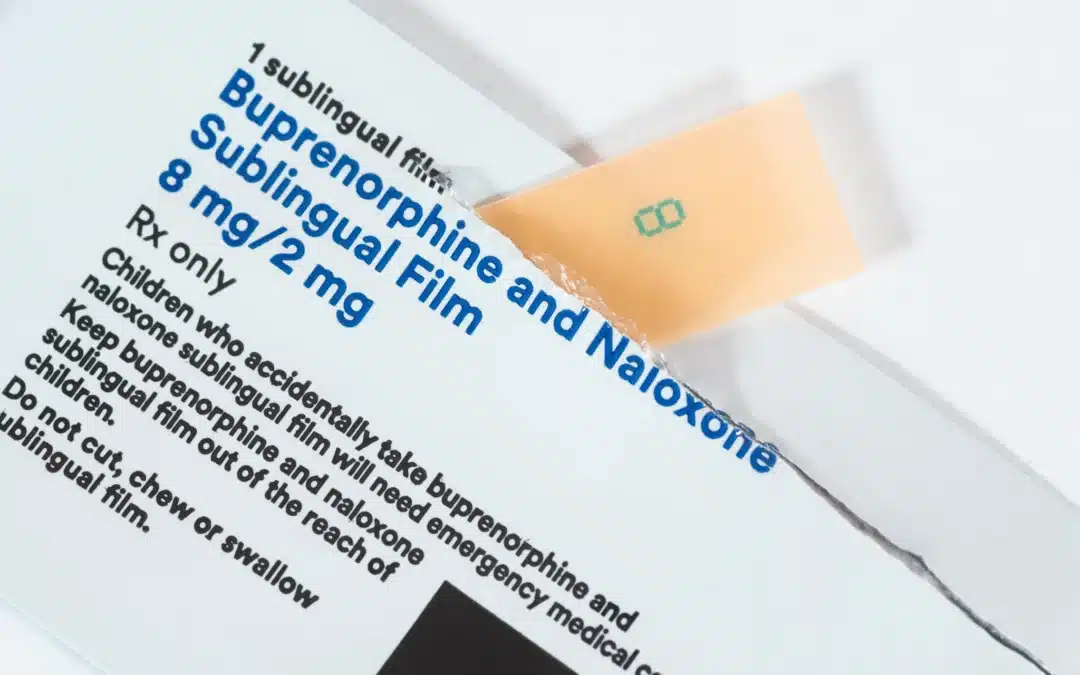

Subutex vs Suboxone comes down to one ingredient. Subutex is buprenorphine by itself. Suboxone is buprenorphine plus naloxone. The buprenorphine is what treats opioid withdrawal and cravings in both. The naloxone is there for a different reason, and it is not the reason most people think.
One more thing to know up front: brand-name Subutex has not been sold in the United States since 2011. When people say “Subutex” today, they almost always mean generic buprenorphine tablets.
This guide covers what each medication is, what the naloxone actually does, why a medical team would choose one over the other, and which one we use at Liberty Health Services.
If you’re in New Hampshire and you have questions about starting Suboxone treatment, call Liberty Health Services at 855.959.4521. Admissions is available around the clock.
What is the difference between Subutex and Suboxone?
| Subutex | Suboxone | |
|---|---|---|
| What is in it | Buprenorphine only | Buprenorphine and naloxone |
| Brand name still sold in the U.S.? | No. Generic buprenorphine tablets only | Yes, as a film. Generics also available |
| How it is taken | Tablet dissolved under the tongue | Film or tablet dissolved in the mouth, usually under the tongue |
| What treats withdrawal and cravings | Buprenorphine | Buprenorphine |
| Built-in deterrent to injecting it | No | Yes, the naloxone |
| How often it is used | In specific medical situations | The standard choice for most patients |
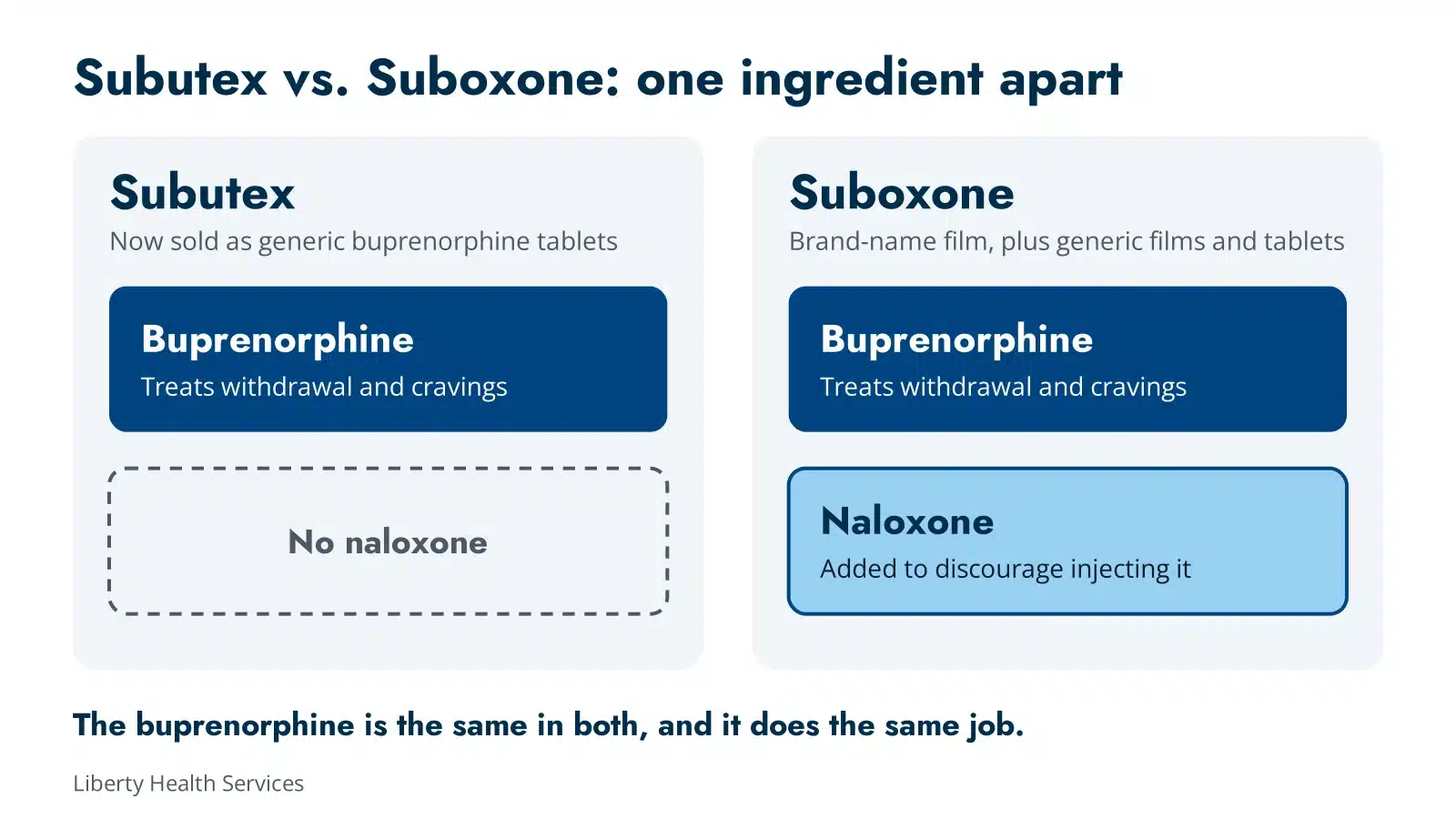
Both are prescription medications for opioid use disorder, both are controlled substances, and both do the same job. If you want the basics on how buprenorphine works, start with what Suboxone is.
Is Subutex still available?
Not under that name. The company that made Subutex stopped selling it in the United States in 2011, after it had moved its focus to the buprenorphine and naloxone combination. That led a lot of people to assume Subutex was pulled because it was dangerous. It wasn’t. The FDA reviewed the question and determined that Subutex was not withdrawn for safety or effectiveness reasons, which is why generic versions are still made.
So the medication exists. It is just called buprenorphine now. If a pharmacy bottle says “buprenorphine sublingual tablets” with no naloxone listed, that is what people mean by Subutex.
Suboxone went through a change of its own, from a tablet to the film most people know today. We cover that in why Suboxone comes as a strip.
What do Subutex and Suboxone look like?
This is one of the most common reasons people look these medications up, often a parent or partner who found something in a pocket, a car, or a bedroom and does not know what it is.
| Medication | What it can look like |
|---|---|
| Buprenorphine tablets (generic Subutex) | Usually a small round white tablet. Common markings include “54” and “411,” “54” and “775,” “RP” and “b8,” “RP” and “b2,” “460,” or “459.” One version is an orange oval stamped “153” or “156.” |
| Buprenorphine and naloxone tablets (generic Suboxone tablets) | Usually a small round orange or peach tablet. Common markings include “54” and “375,” “54” and “122,” “970,” “969,” or “AN” and “415.” One version is white and round, stamped “155” or “154.” |
| Suboxone film | A thin orange rectangle about the size of a breath strip, printed in white with the product and strength. Each one comes sealed in its own foil pouch. |
| Generic buprenorphine and naloxone film | Also a thin orange strip in a sealed pouch, printed with markings such as “A8” or “B8” and “N.” |
These descriptions come from the manufacturers’ FDA labels on DailyMed, and they are a sample. Many companies make these medications. Notice that color will not tell you which one you are looking at, since both come in white and in orange. The markings will. A pharmacist can identify any tablet from its imprint, and so can Poison Control at 1-800-222-1222.
If you found one of these, two things are worth knowing.
First, it does not automatically mean someone is misusing drugs. These are treatment medications. The person may be in recovery and doing exactly what they are supposed to do, and may not have been ready to tell you. It can also mean they are buying it on the street to hold off withdrawal, which is its own sign that they need real help. Either way, the way forward is a calm, direct conversation.
Second, keep it away from children. The FDA label warns that buprenorphine can cause severe, possibly fatal breathing problems in children. If a child may have gotten into it, call 911 right away.
What does the naloxone in Suboxone actually do?
It discourages people from injecting the medication. That is its whole job.
Naloxone is an opioid blocker. When Suboxone is dissolved under the tongue the way it is meant to be taken, very little naloxone gets into your system, and it is intended to stay inactive. If someone who is dependent on opioids dissolves and injects it instead, the naloxone hits all at once and can throw them into withdrawal. That is the deterrent.
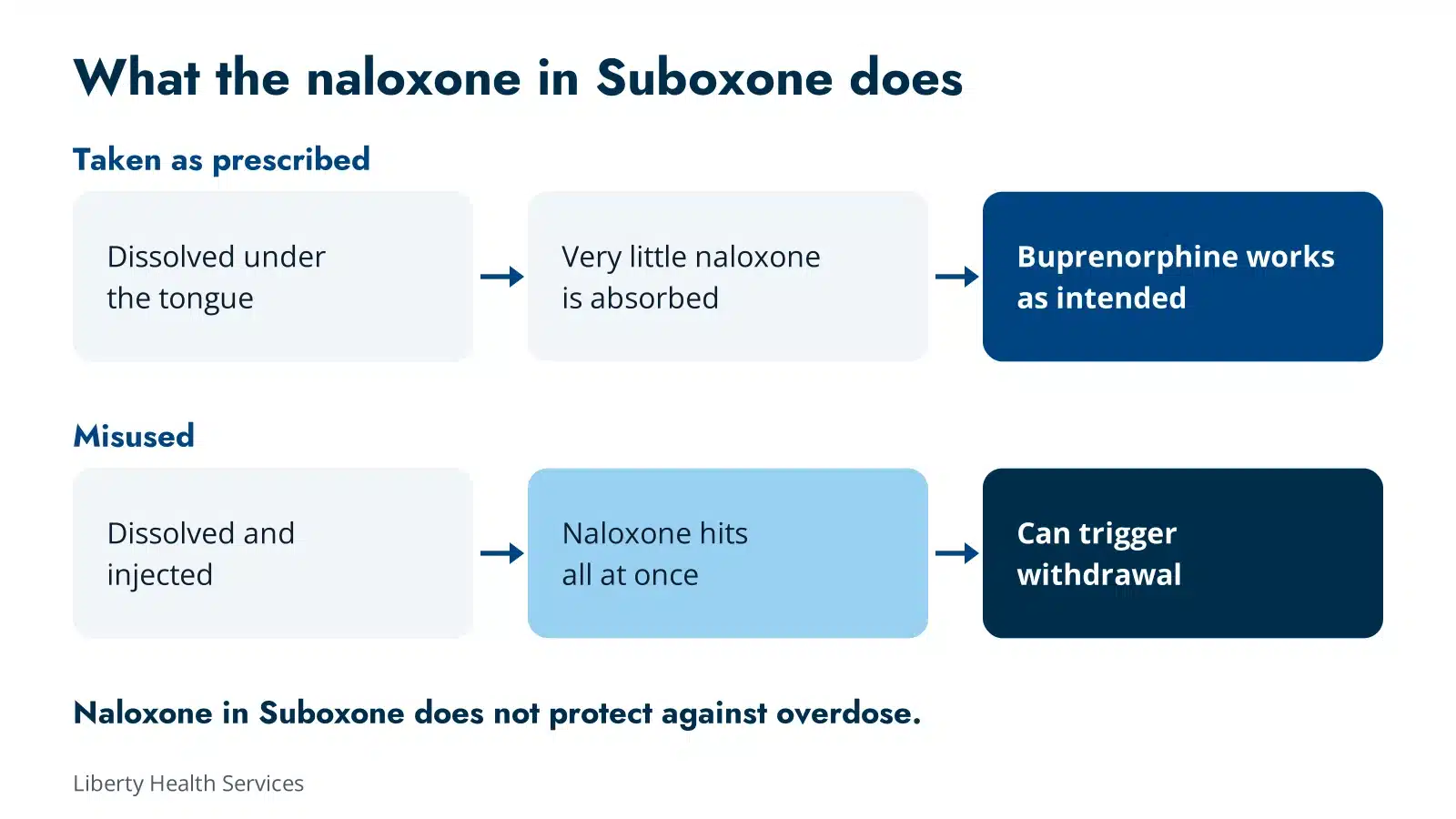
This is where most of the confusion comes from, so here is what the naloxone does not do:
- It does not protect you from an overdose. Taking Suboxone does not make it safe to use fentanyl, heroin, or pain pills. People have overdosed while on it, especially when alcohol or benzodiazepines are involved.
- It is not what “blocks” other opioids. That effect comes from the buprenorphine, which holds tightly to the same receptors. Buprenorphine tablets without naloxone do the same thing.
- It is not what causes precipitated withdrawal. When Suboxone is taken as directed, precipitated withdrawal comes from the buprenorphine pushing other opioids off the receptors. The belief that Subutex is safe to take right after using because it has no naloxone is wrong. It can happen with either medication if it is started too soon, which is a real concern for anyone starting Suboxone after fentanyl.
Do Subutex and Suboxone work the same way?
Yes. Taken as prescribed, they do the same thing, because the same medication is doing the work. Buprenorphine eases withdrawal, quiets cravings, and gives your body something steady in place of the cycle of using and getting sick.
Neither one is stronger. Neither one is the “real” version. A milligram of buprenorphine is a milligram of buprenorphine, whether or not naloxone is riding along with it.
Why do some people say they feel better on Subutex?
Spend any time in online recovery communities and you will see this again and again. Someone switches from Suboxone to buprenorphine alone and says the headaches stopped, the nausea eased, or they just feel more like themselves. Then they are told, sometimes by a professional, that it is impossible because the naloxone does nothing.
That answer is too simple, and the research says so. Naloxone under the tongue is absorbed poorly, but not at zero. A 2024 report by addiction medicine physicians in Harm Reduction Journal points out that naloxone can be detected in nearly everyone taking Suboxone as prescribed. Most people never notice it. In a minority of patients, the authors found, it can contribute to side effects like nausea and headache that go away on buprenorphine alone. They also note that prescribers who were taught naloxone “does nothing” may doubt patients who report this.
Naloxone is also not the only thing that changes in a switch. The Suboxone label itself says that films and tablets are not always equivalent, and that the amount of medication reaching the bloodstream may differ when someone moves from one to the other. Generic tablets also vary from one manufacturer to the next in their inactive ingredients, and people in recovery compare them constantly.
So if you feel different on one than the other, you are not imagining it and you are not alone. It also does not prove that naloxone is hurting you. What it means is that you have real information about how your body responds, and your prescriber needs to hear it.
Why would someone be prescribed buprenorphine without naloxone?
For most people there is no reason to. The combination is the standard. But there are situations where a medical team will choose buprenorphine by itself.
- A reaction to naloxone. The FDA label for Suboxone says it should not be used by anyone with a history of hypersensitivity to buprenorphine or naloxone. A true naloxone allergy is uncommon, but it happens, and some people simply do not tolerate the combination well.
- Serious liver problems. The same label says combination products are not recommended for people with severe liver impairment and may not be right for moderate impairment. A damaged liver clears naloxone much more slowly than it clears buprenorphine, and the two cannot be adjusted separately when they are in one film.
- Pregnancy, in some cases. For years, pregnant patients were routinely switched to buprenorphine alone out of caution. That thinking has shifted. Newer clinical guidance, including a review by Maine’s clinical advisory committee, found no added risk from the combination and noted the earlier practice was not based on clinical data. Today it is an individual decision between a patient and their prescriber.
Which one does Liberty Health Services use?
Suboxone, for most patients, and usually the film. That is the standard of care, and it is what our medical team starts with during opioid detox.
Buprenorphine without naloxone is used here in individual situations, such as a patient who cannot tolerate naloxone. That call is made by our medical team after looking at your history, your health, and what you have taken before. It is one part of how we approach opioid withdrawal management.
Does Subutex get you high?
It can, and some people ask for Subutex for that reason. It is an uncomfortable thing to say out loud, but it is true, and it is the main reason prescribers are careful with it.
The details matter, though, because the street version of this story is half wrong.
Dissolved under the tongue, Subutex does not hit harder than Suboxone. The naloxone in Suboxone is not holding anything back when the medication is taken the way it is prescribed. Anyone who switches to buprenorphine alone expecting a stronger effect from taking it normally is going to be disappointed.
The difference shows up when the medication is misused. Buprenorphine without naloxone can be injected or snorted without the naloxone setting off withdrawal. That gives it a higher street value than Suboxone, a point the Harm Reduction Journal report makes as well, and it is why it gets sold, traded, and asked for by name. The FDA has been clear that the naloxone in Suboxone is there to deter exactly that, and equally clear that it is not a perfect deterrent. Suboxone gets misused too.
How much of a high buprenorphine produces depends on the person. It is a partial opioid, so its effects level off. For someone with a long history of heavy opioid use, it mostly just makes the sickness stop. For someone with little or no tolerance, it can cause a real high and a real overdose, especially mixed with alcohol or benzodiazepines. Injecting it adds its own dangers, including serious infections.
Two things follow from that.
First, if you ask for buprenorphine without naloxone, expect questions. That is not a judgment of you. Plenty of people ask for honest reasons, and the questions are how a medical team tells the difference.
Second, if part of you is asking because you want to feel something, say that. It usually means cravings are not under control or the dose is not right, and both of those are things a medical team can work on. You will get further by telling the truth than by asking for a different pill.
Can you ask for Subutex instead of Suboxone?
You can always bring it up, and you should if you have a reason. If Suboxone has given you headaches, nausea, a rash, or anything else that worried you in the past, tell the medical team. That is useful clinical information, and it is exactly the kind of thing that changes a treatment plan.
A lot of people are afraid that asking will get them labeled a drug seeker, so they say nothing and quietly struggle on a medication that is not sitting right. Asking is not the problem. Hiding the reason is.
What you should expect is a conversation, not an automatic yes. Prescribers want a medical reason before choosing buprenorphine without naloxone, the same care they would take with any controlled medication.
Why is Subutex so hard to get?
Even with a legitimate reason and a willing prescriber, people run into walls. These are the ones that come up most often when patients talk to each other:
- Prescribers who will not write it. Some clinics and telehealth programs prescribe the combination only, as a blanket policy.
- Pharmacies that do not have it. Buprenorphine without naloxone is stocked less often, and some pharmacies ask for documentation of why you need it.
- Insurance. Plans often want a prior authorization explaining why the combination will not work for you. The same 2024 report found that about 93 percent of commercial insurance formularies covered generic Suboxone films with no prior authorization, compared with about 76 percent for buprenorphine tablets.
- Rules that change by state. What is routine in one state can be tightly restricted in the next.
If you are prescribed it, a few things help. Ask your prescriber to document the medical reason in your chart. Call the pharmacy before you are down to your last dose. And if a refill falls through, call your prescriber that day. Running out is how people end up back on something far more dangerous than either of these medications.
Can you switch from one to the other?
Yes, with your prescriber. Because the buprenorphine is the same, moving between the two is usually straightforward when a clinician manages it.
Do not switch on your own, and do not take someone else’s medication because it is “basically the same thing.” The form, the strength, and the timing all matter, and getting them wrong is how people end up in withdrawal or worse.
Frequently asked questions about Subutex and Suboxone
Is Subutex stronger than Suboxone?
No. The buprenorphine is identical, milligram for milligram. Some people do feel different on one than the other, but that is not because one is a stronger medication.
Is Subutex safer than Suboxone?
No. Taken as prescribed, the two are equally safe, because the buprenorphine is the same. Suboxone is not less safe because of the naloxone, and Subutex is not safer because it has fewer ingredients. The one real difference is that Suboxone is harder to misuse.
Does Subutex have naloxone in it?
No. Subutex and generic buprenorphine tablets contain buprenorphine only. Suboxone and its generics contain both.
Why don’t doctors prescribe Subutex very often?
Because the combination works just as well and is harder to misuse. Buprenorphine without naloxone is kept for patients who have a medical reason not to take naloxone.
Do Subutex and Suboxone have different side effects?
Not in any meaningful way, because the buprenorphine is what causes most of them. Headache, nausea, constipation, and trouble sleeping are the common ones, and they tend to ease as your body adjusts. If one form bothers you more than another, tell your prescriber.
Is buprenorphine the same as Subutex?
Yes. Subutex was a brand name for buprenorphine tablets. The brand is gone in the United States, and the generic is simply called buprenorphine.
Is Zubsolv the same as Subutex?
No. Zubsolv is a tablet that contains buprenorphine and naloxone, so it is in the same family as Suboxone, not Subutex.
Are the buprenorphine shots Subutex or Suboxone?
Neither, exactly. Long-acting injections like Sublocade contain buprenorphine without naloxone, but they are a different kind of treatment given by a clinician. We explain them in what Sublocade is.
Can you misuse Subutex or Suboxone?
Yes. Both contain buprenorphine, which is an opioid and a controlled substance. Both are also among the most effective treatments there are for opioid use disorder when they are taken as prescribed. Those two things are both true.
Is Suboxone the only option?
No. Buprenorphine is one of several medications used in medication-assisted treatment. We compare the others in Suboxone vs. methadone and Suboxone vs. Vivitrol.
Suboxone treatment at Liberty Health Services
Subutex and Suboxone are the same medication with one difference, and for most people that difference will never matter. What matters is starting the right medication at the right time, with a medical team watching how you respond.
That is what medical detox is for. After detox, most people continue into residential treatment, where the work on staying well begins.
If you want to know which medication you would be started on and why, ask us. You can call just to ask questions. Reach admissions at 855.959.4521 any time, or verify your insurance online.