
Anxiety, and it isn’t close. We reviewed over 2,000 de-identified patient records from our detox in Derry, New Hampshire. Among the 1,794 of those patients with an alcohol-related diagnosis, 38% also carried an anxiety diagnosis and 31% carried a depression diagnosis. Those two conditions account for the large majority of the mental illness we document alongside alcohol use disorder, and they line up with what the national research has found for decades.
If you searched for “alcoholics,” you’ll notice we say alcohol use disorder (AUD) from here on. It’s the clinical term, it names the condition rather than the person, and it’s what appears on the diagnosis codes this article is built from.
Most articles answering this question cite the same two or three studies. We cite them too, further down. But we also had something most writers don’t: our own records. We pulled roughly five years of de-identified diagnosis data from our electronic medical record, 2,277 unique patients and every diagnosis code our medical and clinical team documented, and counted each person once. These are diagnosis-record counts from one New Hampshire detox, not a national survey, so treat them as a window into who actually shows up for medical detox, not a statement about everyone who drinks.
What our data shows: anxiety first, depression second
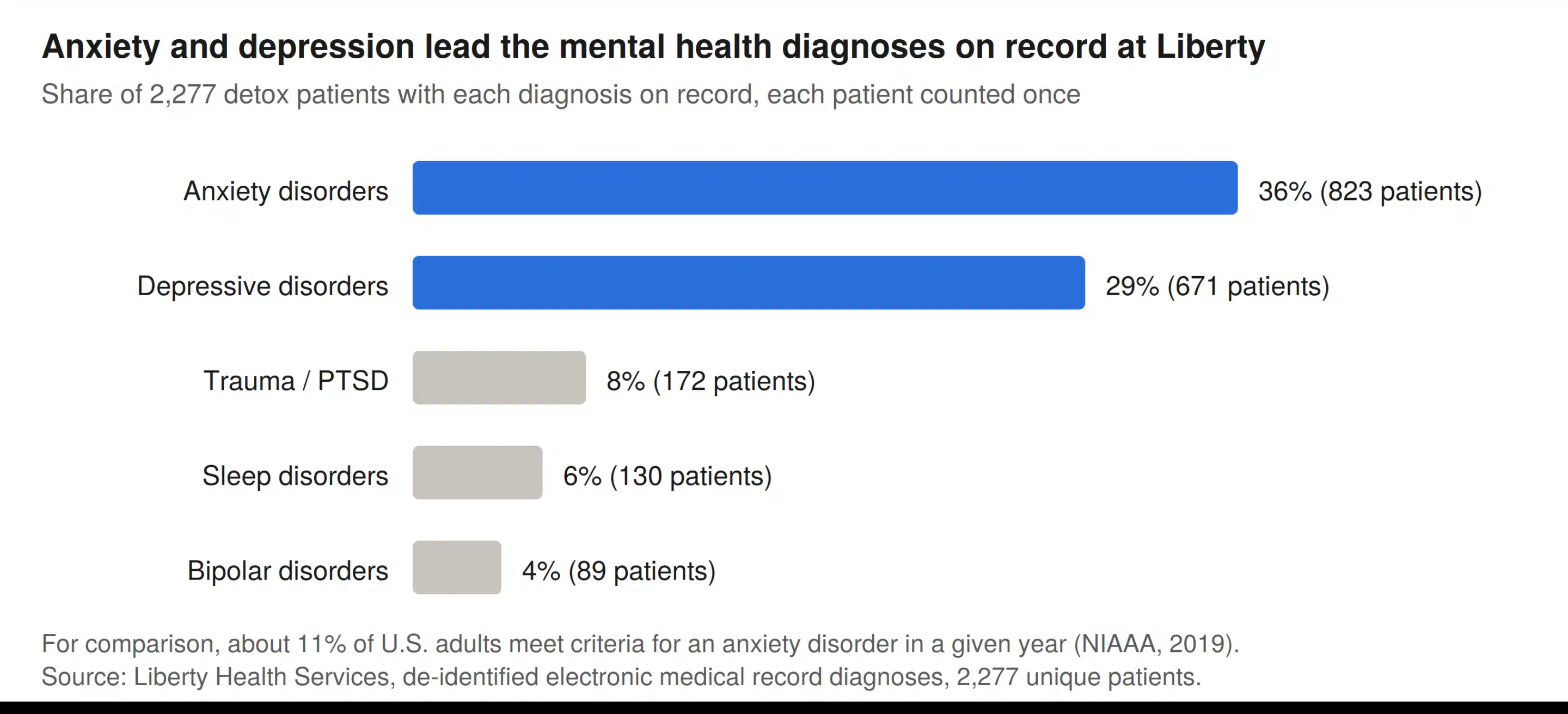
Narrow it to the 1,794 patients with an alcohol-related diagnosis (79% of everyone we’ve treated) and the top two climb: 681 (38%) also had an anxiety diagnosis, 560 (31%) a depression diagnosis, and 130 (7%) a trauma or PTSD diagnosis. Attention-deficit/hyperactivity disorder shows up on about 3% of records overall.
The other number worth sitting with: the average patient left with 3.4 distinct diagnosis codes on their record (median 3). That count includes medical conditions, and some of those are alcohol’s fingerprints too: high blood pressure on 1 in 10 records, elevated liver enzymes, low potassium. Very few people arrive with alcohol use disorder and nothing else.
Two honest caveats. First, these are diagnoses our team documented at some point in a patient’s record, not a measure of what someone is feeling today. Second, the people who come to a medical detox are, by definition, people whose drinking got serious enough to need medical help. The rates among everyone who drinks heavily are lower, which is roughly what the national surveys find.
Why anxiety is the most common mental illness with alcoholism
Our numbers are not unusual. A 2019 review in the National Institute on Alcohol Abuse and Alcoholism’s journal, Alcohol Research: Current Reviews, found that up to 50% of people in treatment for alcohol problems met criteria for at least one anxiety disorder, against about 11% of U.S. adults in a given year. Our 38% sits squarely inside that range.
The order matters, and it usually runs anxiety first. In the same review, anxiety preceded the drinking problem in up to three-quarters of people who had both, most often when the anxiety was social. The mechanism is plain: alcohol works on the same GABA system that anti-anxiety medications target, so the first drink does exactly what a nervous person hopes it will. People with an anxiety disorder who said they drank to cope had five times the risk of developing alcohol dependence within three years. People with the same anxiety disorder who did not drink to cope had no elevated risk at all.
Then the trade turns. With regular heavy drinking the brain compensates, dialing down its own calming signals and dialing up the excitatory ones, so baseline anxiety climbs and each drink buys less relief. By the time someone needs our alcohol detox program in New Hampshire, the drinking is often maintaining the anxiety it was meant to treat.
One detail from our records: the single most common anxiety code is “unspecified anxiety disorder,” on 700 patients, with generalized anxiety disorder a distant second at 133 and panic disorder on 11. That “unspecified” is not sloppiness. It reflects something specific about diagnosing anyone in the first days off alcohol, which we get to below.
Alcoholism and depression: the second most common pairing
In the big national surveys, depression actually edges out anxiety. A 2019 NIAAA review calls depressive disorders the most common psychiatric conditions among people with alcohol use disorder, with major depressive disorder at the top, and the two co-occur far more often than chance would predict. When NIAAA’s National Epidemiologic Survey on Alcohol and Related Conditions looked specifically at people with AUD who sought treatment, 41% had a mood disorder and 33% had an anxiety disorder.
So why does anxiety lead in our records? We think it’s about timing. We’re a detox. Our medical team meets people in their first hours off alcohol, when anxiety is the loudest thing in the room and gets documented first. Depression tends to surface over the following weeks, once the acute symptoms settle, often after someone has moved on to residential treatment. Either way, 31% of our patients with an alcohol diagnosis also carry a depression diagnosis, which is well within what the national data predicts.
The relationship runs both directions. Depression drives drinking: alcohol numbs, briefly. Drinking drives depression: alcohol is a central nervous system depressant, it fragments sleep, and over years it tends to take the job, the marriage, and the friendships that protect against low mood. A common misconception is that most depression in heavy drinkers is simply the alcohol talking and will clear on its own. The same NIAAA research found the opposite: alcohol-induced depression, the kind that resolves with sobriety alone, accounts for a small share of cases. Most people with both conditions have an independent depression that needs its own treatment, and it does not get better just because the drinking stops.
In our records, “depression, unspecified” is the code on 535 patients. Roughly 70 carry a specific major depressive disorder code, usually recurrent.
PTSD, bipolar disorder, ADHD, and insomnia: the rest of the list
After anxiety and depression, the numbers drop off fast, but each of these changes how detox and treatment should be run.
Trauma and PTSD appear on 7% of our alcohol-related records. We are confident that is an undercount. People rarely disclose trauma in their first 72 hours in an unfamiliar building with strangers taking their vitals; it tends to come out weeks later in individual therapy. When it does, it reorganizes the treatment plan, because drinking to blunt hypervigilance and nightmares is one of the most durable patterns we see.
Alcohol and bipolar disorder is the pairing families ask about most, relative to how often it shows up (about 4% of our patients). The two are hard to untangle. A manic episode can look like a drinking binge, a binge can trigger one, and the mood crash after heavy drinking can be mistaken for a depressive phase. It matters for detox specifically because several medications used in withdrawal and in mood stabilization interact, so our prescriber needs to know about a bipolar diagnosis, or a suspected one, before the first dose.
Sleep disorders are formally diagnosed in about 6% of patients, which understates the problem: nearly everyone in alcohol withdrawal sleeps badly. The 6% are the people whose insomnia had its own history before the drinking, or persisted long after it.
ADHD sits on about 3% of records. Untreated ADHD and alcohol are a known pairing, and the stimulant medications used to treat it raise their own questions during early recovery, which is a conversation for the clinical team, not a webpage.
Finally, mental illness isn’t the only thing that travels with alcohol use disorder. Among our alcohol-related patients, 23% also had a nicotine diagnosis and 12% an opioid diagnosis. One in three patients across the whole dataset had diagnoses in two or more substance categories.
How our numbers compare with the national studies
Our rates land between what the national surveys find in people with alcohol dependence and what they find in people who actually seek treatment for it, which is exactly where a detox population should land.
| Condition | Liberty, patients with an alcohol diagnosis (n = 1,794) | U.S. adults with alcohol dependence, past year | People in treatment for alcohol | Sources |
|---|---|---|---|---|
| Any anxiety disorder | 38% | 23% | 33% of treatment-seekers; up to 50% in treatment samples | NESARC, NIAAA 2019 review |
| Depression | 31% | 20% major depression (28% any mood disorder) | 41% any mood disorder | NESARC |
| Bipolar disorder | 4% | 8% mania | 42% of people treated for bipolar disorder have an alcohol problem (the reverse direction) | NESARC, Hunt et al. 2016 |
| Trauma / PTSD | 7% | About 7% of trauma-exposed U.S. adults in a given year; consistently higher among people with AUD, no single national figure | — | NIAAA 2018 review |
| ADHD | About 3% | — | 23% of patients in substance use treatment | Meta-analysis of 29 studies |
| Any mental illness | At least 38% (we can’t yet count the overlap between conditions) | 44% of adults with any substance use disorder | 33% of all treatment admissions flagged a psychiatric problem; 44% of alcohol admissions in one state system | NSDUH 2023, TEDS, Maryland |
The national column comes from NIAAA’s National Epidemiologic Survey on Alcohol and Related Conditions, 43,000 face-to-face interviews, and counts only independent disorders, meaning anxiety or depression that was not caused by the alcohol itself. Our codes don’t make that distinction, which is one reason ours run higher. Three things in the table are worth reading closely.
Severity explains most of the gap. Nearly three-quarters of our patients carry the severe alcohol use disorder code. Nationally, among everyone with a past-year alcohol use disorder, only 19% are severe and 59% are mild. Co-occurrence climbs with severity: in the NESARC data, anxiety disorders appear in 12% of people with alcohol abuse but 23% of people with alcohol dependence, and mood disorders in 12% versus 28%. Compare us with the mild end of the spectrum and we look like an outlier. Compare us with the dependent, treatment-seeking end, which is who we actually treat, and we look like the textbook.
Where we run higher, it’s withdrawal. Our 38% anxiety figure is above the 23% for alcohol dependence and the 33% for treatment-seekers, but inside the up-to-50% range from studies of people in alcohol treatment. The difference is that our team documents the anxiety in front of them in the first days off alcohol, including the share that is withdrawal-driven. The survey definitions screen that share out.
Where we run lower, it’s detection, not a healthier population. ADHD is the starkest row: it appears on about 3% of our records against 23% of people in substance use treatment in the pooled research. Detox doesn’t screen for ADHD, and an adult diagnosis requires a childhood history nobody takes in the first 72 hours. The same logic applies to trauma, which people disclose weeks into treatment, not at a vitals check. If anything, these rows mean our records understate the mental illness in the people we treat, not the reverse.
One caveat on the benchmark itself: the NESARC figures come from 2001–2002 interviews using the older DSM-IV definitions. They remain the numbers nearly every review cites because the follow-up survey, NESARC-III, reported the strength of the associations rather than these percentages.
Anxiety and depression after quitting drinking: is it withdrawal, or is it you?
For the first week, nobody can tell you, and anyone who claims they can is guessing. That is the real reason so many of our codes say “unspecified.”
Alcohol withdrawal manufactures anxiety. Within 6 to 12 hours of the last drink the rebound starts: racing heart, dread, shaking, a panic that has no object. It peaks around day two or three, which is also the window for the dangerous complications, and we walk through all of it in our day-by-day alcohol withdrawal guide. Low mood arrives close behind, usually day two onward, and for some people a flatter, duller version lingers for weeks as post-acute withdrawal. Someone in that state meets every symptom checklist for an anxiety disorder and most of the one for depression. The diagnostic manuals handle this by calling the condition alcohol-induced unless the symptoms clearly came first or stick around well into sobriety.
So the honest test is time. If the anxiety or depression is still there a month into sobriety, it is almost certainly its own condition, and the national data says that is the usual outcome, not the exception. What we refuse to do is make you white-knuckle it for a month to find out. During detox our team monitors withdrawal symptoms on a standardized scale and uses medication to bring the rebound down, which is a large part of how we manage alcohol withdrawal. A psychiatric evaluation happens early, and when someone arrives on an antidepressant or anti-anxiety medication, continuing it is the default, not the exception. Bring the bottle.
If the low mood has turned into not wanting to be here: that is a symptom of what alcohol and withdrawal do to the brain, not a conclusion about your life. Call or text 988 now, any hour. Then call us, because detox under medical supervision is the fastest way to get the chemistry working against you back on your side.
Is alcoholism itself a mental illness? Yes, and that’s why treating one condition at a time fails
Alcohol use disorder is a diagnosis in the DSM-5, the same manual that defines anxiety disorders and depression. It is graded mild, moderate, or severe by how many of eleven criteria someone meets, and 1,651 of our patients, nearly three-quarters, carried the severe code. Calling it a mental illness isn’t a softening of the word “alcoholic.” It’s the clinical fact, and it changes what good treatment looks like.
The older view was that AUD and, say, anxiety were two separate illnesses that happened to sit in the same person, so you could treat them in sequence: dry out first, deal with the anxiety later. The research has been unkind to that idea. The NIAAA review cited above describes the two conditions as sharing the same stress-response circuitry, each one making the other more likely, and reports two findings that should shape anyone’s expectations:
- After intensive residential treatment for alcohol, 52% of people with a co-occurring anxiety or mood disorder returned to drinking within four months, versus 21% of people without one. Untreated anxiety or depression more than doubles the odds that detox doesn’t hold.
- Treating the anxiety or depression on its own doesn’t fix the drinking either. Across 15 randomized trials that added medication or cognitive behavioral therapy for the co-occurring condition to standard alcohol treatment, symptoms of anxiety and depression improved, but drinking outcomes barely moved.
Read together, those two results say the same thing from both sides. Neither condition can be parked. The person who leaves detox with a stabilized body and an untreated anxiety disorder is, statistically, the person who is back within the season, and the person whose depression gets treated while the drinking continues gets a better mood and the same liver. Treatment has to address both, at the same time, by the same team.
What this means if you’re the one drinking
If you drink heavily and you also live with anxiety, low mood, panic, or sleep that never comes, you are not an unusual case. You are the typical case. Two out of five people who walk through our door with an alcohol diagnosis have an anxiety diagnosis next to it, and nearly one in three has depression. Nobody on our staff is going to be surprised by you.
Here is what that looks like at Liberty Health Services. Admissions asks about mental health history and current medications on the first call, because it changes the detox plan. The medical team manages withdrawal and, when it’s clinically appropriate, starts or continues medication for anxiety or depression during detox rather than after it. A psychiatric evaluation happens early. When detox ends, the same conditions follow you into our alcohol addiction treatment program, where the therapy is built around both the drinking and whatever the drinking was managing.
One honest limit: we are a medical detox and residential program, not a psychiatric hospital. If your assessment shows a level of psychiatric care we don’t provide, we’ll tell you that on the first call and help you get to the right place rather than admit you to the wrong one.
If you’re not sure whether your drinking has crossed that line, the fact that you’re reading an article about mental illness and alcohol at this hour is worth noticing. Call 855.959.4521 or verify your insurance online. The conversation is confidential, and no one on the other end will be surprised.
FAQ: mental illness and alcohol use disorder
What percentage of alcoholics have depression?
In our records, 31% of patients with an alcohol-related diagnosis also carry a depression diagnosis. Nationally, among people with alcohol use disorder who sought treatment, about 41% had a mood disorder, a category that includes depression and bipolar disorder. Among everyone with AUD, treatment-seeking or not, the rate is lower.
What percentage of alcoholics have anxiety?
About 38% of our alcohol-related patients have an anxiety diagnosis on record. Studies of people in treatment for alcohol problems put it as high as 50%, compared with roughly 11% of U.S. adults in a given year.
Is alcoholism a mental illness or a disease?
Both, and the distinction doesn’t change the treatment. Alcohol use disorder is a formal diagnosis in the DSM-5, which makes it a mental disorder by definition, and the changes it produces in the brain’s reward and stress systems are physical, which is why it is also described as a chronic brain disease. Either way it responds to medical and psychological treatment and does not respond well to willpower alone.
Does alcohol cause depression, or does depression cause drinking?
Both directions are real and both are common. Anxiety tends to come first and the drinking follows as self-medication; with depression the order varies more. What the research is clear on is that once both are present, each one feeds the other, and most of the depression seen in heavy drinkers is an independent condition rather than a temporary effect of the alcohol.
Can you keep taking antidepressants while detoxing from alcohol?
In most cases, yes, and stopping them abruptly is its own risk. Our medical team reviews every medication at intake, checks it against the withdrawal protocol, and continues it when that’s safe. Bring your prescriptions with you and tell admissions what you take on the first call.
How long does anxiety last after quitting drinking?
Withdrawal anxiety usually peaks between 48 and 72 hours after the last drink and eases noticeably within the first week, though a lower-grade version can come and go for several weeks. Anxiety that is still present a month into sobriety is very likely an anxiety disorder in its own right and should be evaluated and treated as one.
My husband drinks heavily and I think he’s also depressed. Which gets treated first?
The drinking has to be addressed first for safety, because alcohol withdrawal can be medically dangerous and depression is not treatable in someone who is intoxicated most of the day. But “first” means hours, not months. In a medical detox, the mental health evaluation happens during withdrawal, and treatment for the depression starts alongside the alcohol treatment rather than after it.
If I get my anxiety treated, can I go back to drinking normally?
For someone whose drinking has reached the point of needing detox, no, and we’d rather say that plainly than have you find out the hard way. The research on this is direct: treating the anxiety improves the anxiety and does almost nothing to the drinking. Severe alcohol use disorder doesn’t revert to social drinking once the reason you started is resolved. The brain changes that make it severe are the thing being treated.