

The Beck Depression Inventory (BDI) is a widely used questionnaire that measures the severity of depressive symptoms. But what happens when someone completes the assessment while going through alcohol withdrawal?
Consider someone who stopped drinking three days ago. They’re exhausted, haven’t slept properly, have little appetite, and are having trouble concentrating. If they completed a depression assessment that day, several of their responses might indicate significant depressive symptoms.
Does that mean they have major depressive disorder?
Not necessarily. Alcohol withdrawal and depression share several symptoms, and research suggests that some of those symptoms can change substantially during the first few weeks without alcohol.
Understanding how the Beck Depression Inventory works, which symptoms it measures, and how alcohol use can influence the results helps explain why depression screening is only one part of a mental health assessment.
What Is the Beck Depression Inventory?
The Beck Depression Inventory is a self-report questionnaire developed by psychiatrist Aaron T. Beck and colleagues to measure depressive symptoms.
The original assessment was introduced in 1961. A revised version, the Beck Depression Inventory-II (BDI-II), was published in 1996 and remains widely used in clinical and research settings.
The BDI-II contains 21 items that measure emotional, cognitive, and physical symptoms associated with depression. Each item asks the person to describe their experiences over the previous two weeks, including the day they complete the questionnaire.
According to Pearson, the publisher of the BDI-II, the assessment measures the intensity of depressive symptoms and can support clinical evaluation.
It generally takes about five to ten minutes to complete.
The Beck Depression Inventory is not a standalone diagnostic test. It measures reported symptoms but cannot independently determine whether someone has major depressive disorder or what caused their symptoms.
That limitation is particularly important when evaluating people with alcohol use disorder.
Beck Depression Inventory Scoring: What Do BDI-II Scores Mean?
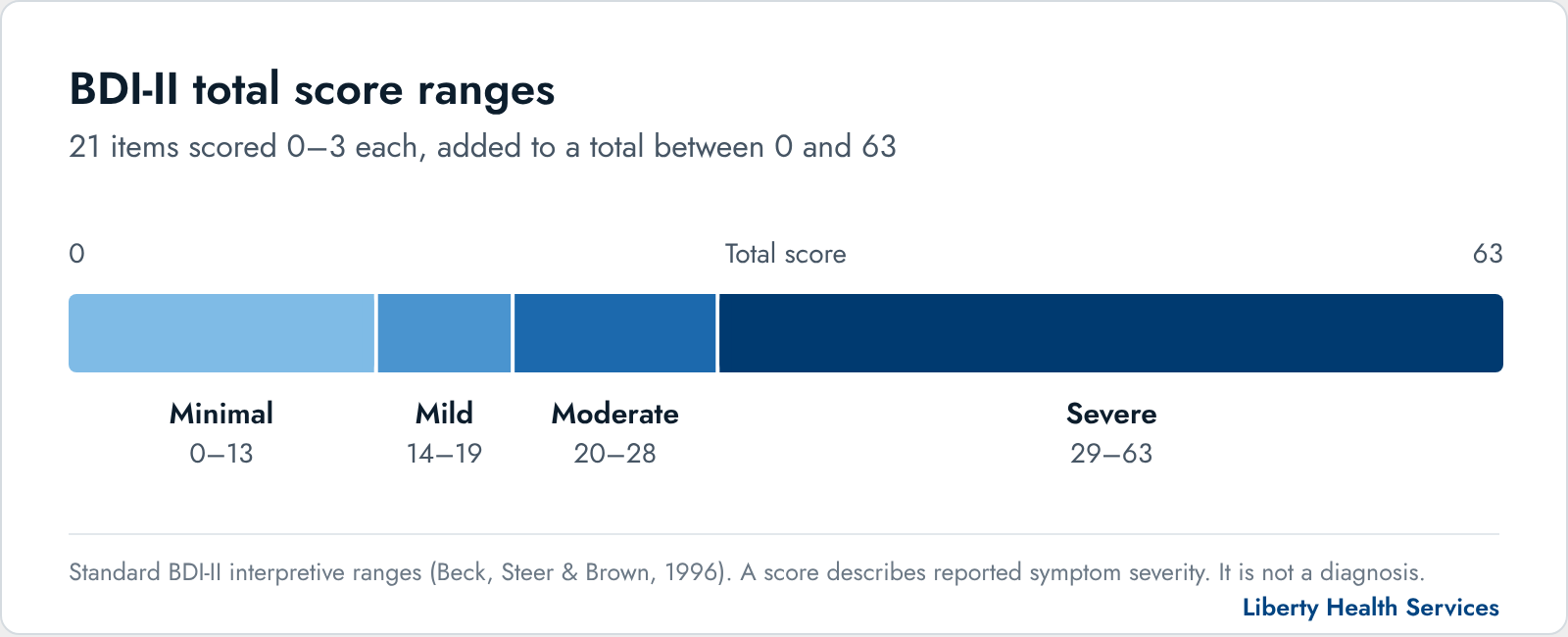
The BDI-II includes 21 items, each scored from 0 to 3. The responses are added together to produce a total score between 0 and 63.
Higher scores indicate greater reported depressive symptom severity.
The standard BDI-II scoring ranges are:
| BDI-II score | Symptom severity |
|---|---|
| 0–13 | Minimal |
| 14–19 | Mild |
| 20–28 | Moderate |
| 29–63 | Severe |
These ranges apply to the BDI-II. Earlier versions of the Beck Depression Inventory use different interpretive guidelines.
For example, a score of 24 falls within the moderate symptom range. A score of 32 falls within the severe range.
However, neither score establishes a diagnosis.
A clinician interpreting the results may consider the person’s psychiatric history, current symptoms, medications, physical health, and substance use.
Someone who scores 32 during acute alcohol withdrawal may have a very different clinical picture from someone who scores 32 after several months of abstinence.
The number matters, but the circumstances surrounding it matter just as much.
Which Beck Depression Inventory Questions Can Be Affected by Alcohol Withdrawal?
One of the challenges of interpreting depression screening results during alcohol withdrawal is that several BDI-II items measure symptoms that are also common during withdrawal and early abstinence.
The BDI-II measures more than sadness. It includes questions about sleep, appetite, fatigue, concentration, irritability, guilt, and other experiences.
Some of these symptoms may be directly influenced by the physical effects of alcohol withdrawal. Others may reflect emotional distress, an underlying depressive disorder, or a combination of factors.
BDI-II items that overlap with alcohol withdrawal symptoms
The following are selected BDI-II item topics, not reproductions of the questionnaire’s copyrighted response statements.
| BDI-II item | Symptom measured | Possible overlap with alcohol use or withdrawal |
|---|---|---|
| #16 | Changes in sleeping pattern | Insomnia and disrupted sleep |
| #20 | Tiredness or fatigue | Physical exhaustion and poor sleep |
| #18 | Changes in appetite | Nausea, reduced appetite, and other eating changes |
| #19 | Concentration difficulty | Difficulty focusing or thinking clearly |
| #11 | Agitation | Restlessness during withdrawal |
| #17 | Irritability | Increased irritability during early abstinence |
| #4 | Loss of pleasure | Reduced enjoyment of everyday activities |
| #5 | Guilty feelings | Emotional distress that may accompany problematic drinking |
| #8 | Self-criticalness | Negative thoughts about oneself |
| #9 | Suicidal thoughts or wishes | A serious safety concern requiring prompt evaluation |
These overlaps do not mean the symptoms should automatically be attributed to alcohol withdrawal.
For example, difficulty sleeping might reflect withdrawal, depression, anxiety, an independent sleep disorder, or several factors occurring together.
Similarly, feelings of guilt or self-criticism cannot be assumed to result from alcohol use.
The BDI-II measures how strongly someone reports experiencing these symptoms. Understanding why they are occurring requires additional assessment.
What Happens to Beck Depression Inventory Scores During the First Weeks Without Alcohol?
Research suggests that depressive symptom scores can change considerably during early alcohol abstinence.
A 2019 study published in the Journal of Dual Diagnosis examined changes in depressive symptoms among 87 participants undergoing inpatient alcohol detoxification.
Researchers administered the BDI-II twice within approximately ten days.
The study found a statistically significant decrease in overall depressive symptom scores, with a moderate effect size (Cohen’s d = 0.53).
This finding suggests that depression screening results obtained early in detox may differ meaningfully from results obtained even a short time later.
However, the study did not establish that all depressive symptoms were caused by withdrawal. A decrease in scores also does not mean every participant’s depression resolved.
To better understand how individual symptoms can change, it helps to look at research that examined the separate items of the Beck Depression Inventory.
Research tracking individual depressive symptoms after stopping alcohol
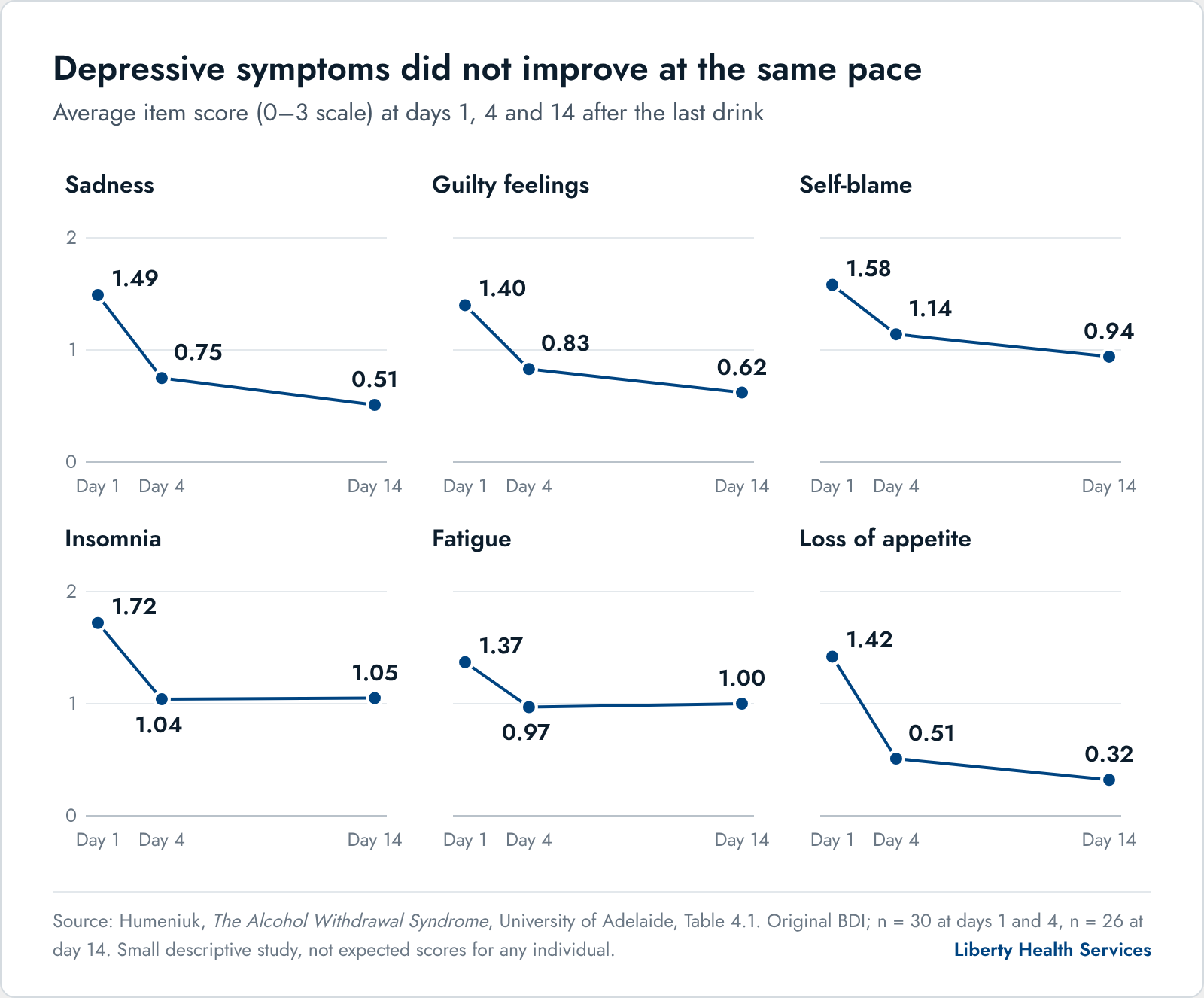
A University of Adelaide doctoral study examined depression and alcohol withdrawal in a group of 30 patients receiving inpatient withdrawal treatment.
Participants completed the original Beck Depression Inventory at several points following their last drink, including days 1, 4, 14, 42, and 70.
Researchers examined overall depression scores and the responses to individual items.
The following chart and table present selected findings from the first two weeks.
| Depressive symptom | Day 1 | Day 4 | Day 14 |
|---|---|---|---|
| Sadness | 1.49 | 0.75 | 0.51 |
| Guilty feelings | 1.40 | 0.83 | 0.62 |
| Self-blame | 1.58 | 1.14 | 0.94 |
| Insomnia | 1.72 | 1.04 | 1.05 |
| Fatigue | 1.37 | 0.97 | 1.00 |
| Loss of appetite | 1.42 | 0.51 | 0.32 |
Source: Rachel Emilie Humeniuk, The Alcohol Withdrawal Syndrome: Characterisation, Predictors of Severity, and Relationship to Relapse, University of Adelaide, Table 4.1.
Values are mean individual-item scores on a 0–3 scale, rounded to two decimal places. The study used the original BDI rather than the BDI-II. There were 30 participants at days 1 and 4 and 26 at day 14. These are descriptive findings from a small historical study, not expected scores for individual patients.
Several patterns stand out.
Appetite improved more quickly than some other symptoms. The average appetite-related item score fell from 1.42 on day 1 to 0.32 by day 14.
Sleep difficulties remained relatively elevated. The average insomnia item score decreased during the first four days but remained around 1.05 at day 14.
Self-blame declined more gradually. The average score dropped from 1.58 on day 1 to 0.94 at day 14.
These findings illustrate an important consideration: depressive symptoms don’t necessarily improve together or at the same rate.
The study was small, used an earlier version of the inventory, and cannot establish what caused each change. Nevertheless, it provides an example of why looking beyond a total depression score can be clinically informative.
Why physical symptoms and emotional symptoms may follow different timelines
Someone who stops drinking may begin eating more normally as withdrawal-related nausea improves, yet continue experiencing insomnia or fatigue.
At the same time, feelings of guilt, low self-worth, or difficulty enjoying everyday activities may remain significant even as physical symptoms improve.
This doesn’t establish that emotional symptoms are independent of alcohol use. It does show why improvements in physical health don’t always translate into immediate improvements in every aspect of mood.
The distinction is particularly relevant when considering depression assessments during early sobriety.
A person may report fewer physical symptoms two weeks after stopping alcohol but continue experiencing emotional difficulties that warrant further evaluation.
Can the Beck Depression Inventory Be Used During Alcohol Withdrawal?
Yes. The Beck Depression Inventory may be administered during alcohol withdrawal when someone is medically and cognitively able to complete the assessment reliably.
However, the results require careful interpretation.
Acute alcohol withdrawal can cause insomnia, anxiety, agitation, fatigue, difficulty concentrating, and changes in mood.
Because these symptoms overlap with those measured by the BDI-II, a score obtained during withdrawal may reflect several different conditions or experiences.
The American Society of Addiction Medicine (ASAM) recommends assessing people for mental health conditions during alcohol withdrawal but cautions against diagnosing a new primary psychiatric disorder based solely on symptoms occurring during acute withdrawal.
An initial depression assessment may help identify current concerns and provide information for subsequent evaluations.
However, a person experiencing severe confusion, delirium, or medical instability may not be able to complete a self-report questionnaire reliably.
Why the BDI-II’s two-week reporting period matters
The BDI-II asks respondents to describe symptoms experienced during the previous two weeks.
Consider someone who completes the assessment seven days after their last drink.
Their answers still cover a period when they were actively drinking, as well as the first week of abstinence.
If they complete the questionnaire again after four weeks without alcohol, its two-week reporting period falls entirely within abstinence.
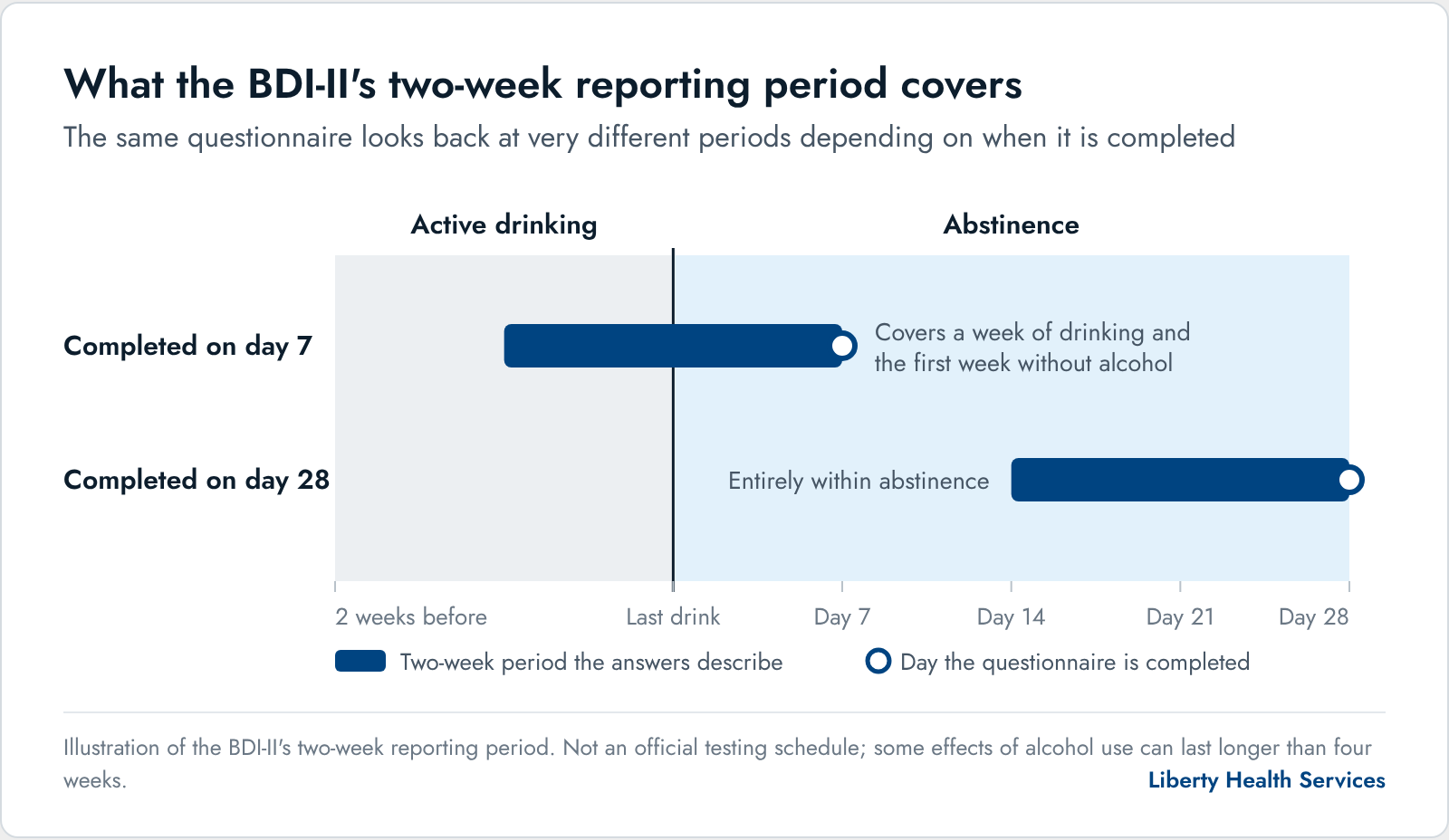
That later result may offer a clearer picture of depressive symptoms without the same direct overlap with the period of active drinking or acute withdrawal.
However, some effects of alcohol use can persist longer than four weeks, and a later score still requires clinical interpretation.
How Long After Quitting Alcohol Can You Establish a Depression Baseline?
There is no single point at which depression screening results become completely unaffected by alcohol.
However, approximately three to four weeks of abstinence is an important period in research examining alcohol-induced depressive symptoms.
A 2019 review published in Alcohol Research: Current Reviews, titled Alcohol Use Disorder and Depressive Disorders, explains that depressive symptoms associated with alcohol use often improve during the first several weeks of abstinence.
The review identifies approximately four weeks as a commonly recommended period after which persistent depressive symptoms can support greater diagnostic confidence in an independent depressive disorder.
This does not mean someone must wait four weeks before being evaluated or treated for depression.
Mental health assessment can begin during detox, and significant symptoms should be addressed as they occur.
Depression assessment throughout early alcohol recovery
| Time since last drink | Clinical considerations |
|---|---|
| Days 1–3 | Acute withdrawal may substantially affect sleep, mood, and concentration |
| Days 4–7 | Physical withdrawal may improve, although overlapping symptoms can remain |
| Weeks 1–2 | Changes in symptoms may become more apparent as the person stabilizes |
| Weeks 3–4 | Continued abstinence may provide a clearer opportunity to evaluate persistent depressive symptoms |
| After 4 weeks | Persistent symptoms may warrant further evaluation for an independent depressive disorder |
These are general clinical considerations, not an official BDI-II testing schedule.
Someone who reports severe depressive symptoms during the first days of abstinence may improve considerably over the following weeks. Another person may continue to experience depression long after withdrawal resolves.
Both situations deserve appropriate clinical attention.
For a closer look at why mood can change after someone stops drinking, read our article on depression after quitting drinking.
Can Depression Scores Improve After Alcohol Detox?
Yes. Studies have documented meaningful reductions in depressive symptom scores during early abstinence.
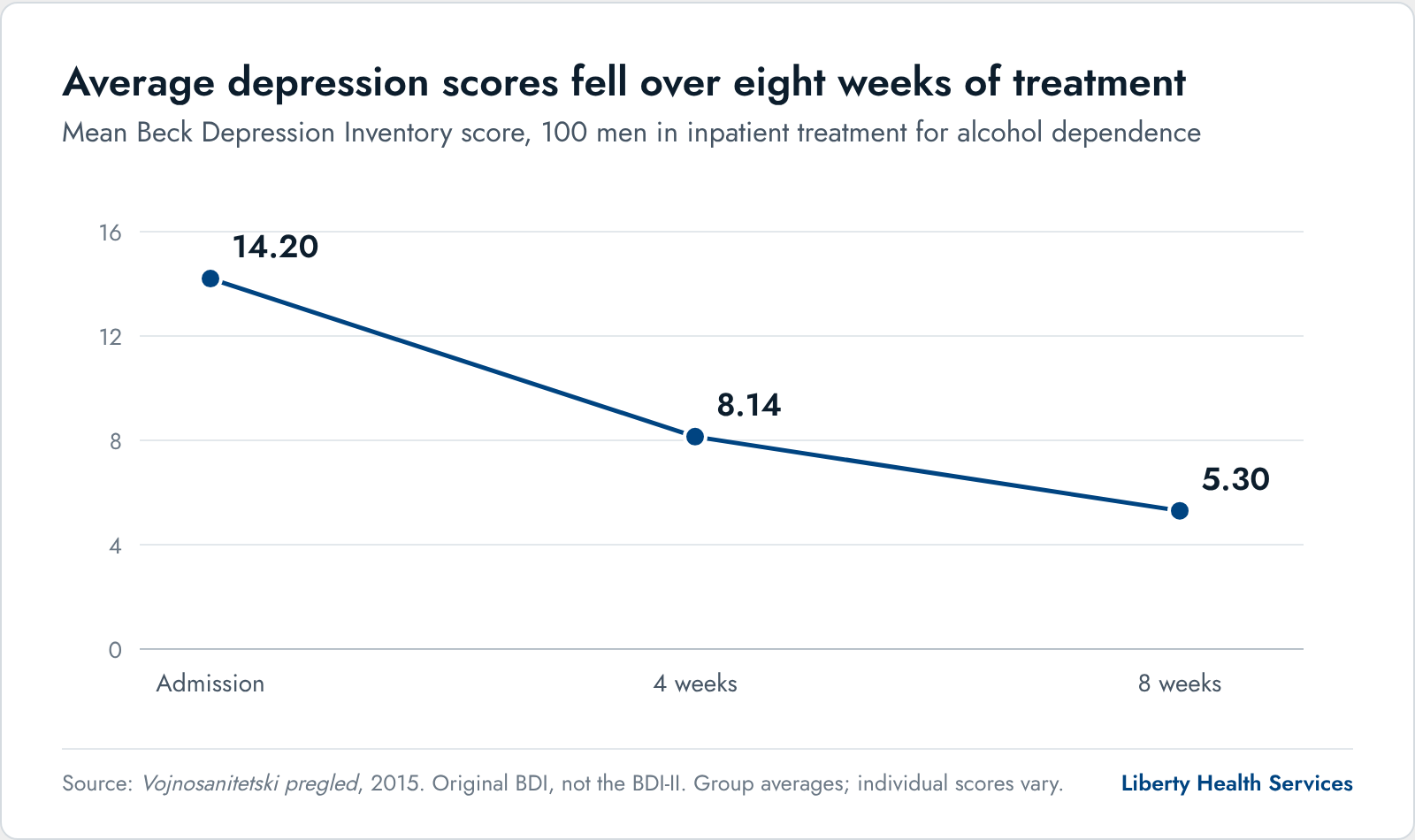
A 2015 study published in Vojnosanitetski pregled followed 100 men receiving inpatient treatment for alcohol dependence.
Researchers measured depression at admission, after four weeks, and after eight weeks using the original Beck Depression Inventory and the Hamilton Depression Rating Scale.
The average BDI score declined from 14.20 at admission to 8.14 after four weeks and 5.30 after eight weeks.
The researchers also observed that certain symptoms, including self-blame, guilt, and loss of pleasure, remained prominent during recovery.
These findings support the importance of considering both total depression scores and individual symptoms over time.
However, the study involved men receiving inpatient treatment and used the original BDI rather than the BDI-II. Its findings should not be used to predict exactly how an individual person’s scores will change.
Improvement during abstinence also does not establish that depression was caused exclusively by alcohol.
Is the BDI-II Accurate for People With Alcohol Use Disorder?
Research supports the BDI-II as a potentially useful depression screening tool in people with alcohol use disorder, although standard scoring thresholds may need careful interpretation.
A 2022 study published in Psychiatry Research evaluated 127 patients receiving treatment for alcohol use disorder in Norway.
Researchers compared the BDI-II and another screening questionnaire with structured clinical interviews used to evaluate major depressive disorder.
Fourteen percent of the participants met the study’s diagnostic criteria for major depressive disorder.
The researchers found that the BDI-II cutoff that performed best in their sample was approximately 25, with sensitivity of 80% and specificity of 78%.
That threshold was higher than cutoffs commonly used to identify depressive symptoms in general populations.
However, a BDI-II score of 25 is not a universal diagnostic cutoff for people with alcohol use disorder.
A score below 25 does not rule out major depression, and a score above 25 does not confirm it.
The findings reinforce the need to evaluate screening results alongside clinical history and other diagnostic information.
Can the Beck Depression Inventory Tell the Difference Between Alcohol-Induced Depression and Major Depression?
No. The Beck Depression Inventory measures depressive symptoms but cannot independently determine their cause.
Alcohol-induced depressive disorder involves clinically significant depressive symptoms associated with alcohol intoxication, withdrawal, or other effects of alcohol use.
Major depressive disorder is a separate psychiatric condition that may occur independently of alcohol use.
The two can also occur together.
Clinicians evaluating depression in someone with alcohol use disorder may consider:
- Whether depressive symptoms began before heavy drinking
- Whether the person has experienced depression during previous periods of abstinence
- How symptoms change after stopping alcohol
- Whether there is a personal or family history of depressive disorders
- Whether symptoms persist beyond the acute withdrawal period
The relationship between depression and alcohol use is not always straightforward.
Some people drink to manage existing depression, while others experience mood symptoms associated with prolonged alcohol use. Still others have both conditions.
A thorough assessment considers these possibilities rather than relying on one questionnaire result.
Why Depression Screening Matters in Alcohol Addiction Treatment
Alcohol use disorder and depressive disorders frequently occur together.
At Liberty Health Services, our de-identified patient records reflect that overlap.
Across more than five years of care, 1,794 patients had an alcohol-related diagnosis documented. Of those patients, 560—approximately 31.2%, or nearly one in three—also had a depressive-disorder diagnosis.
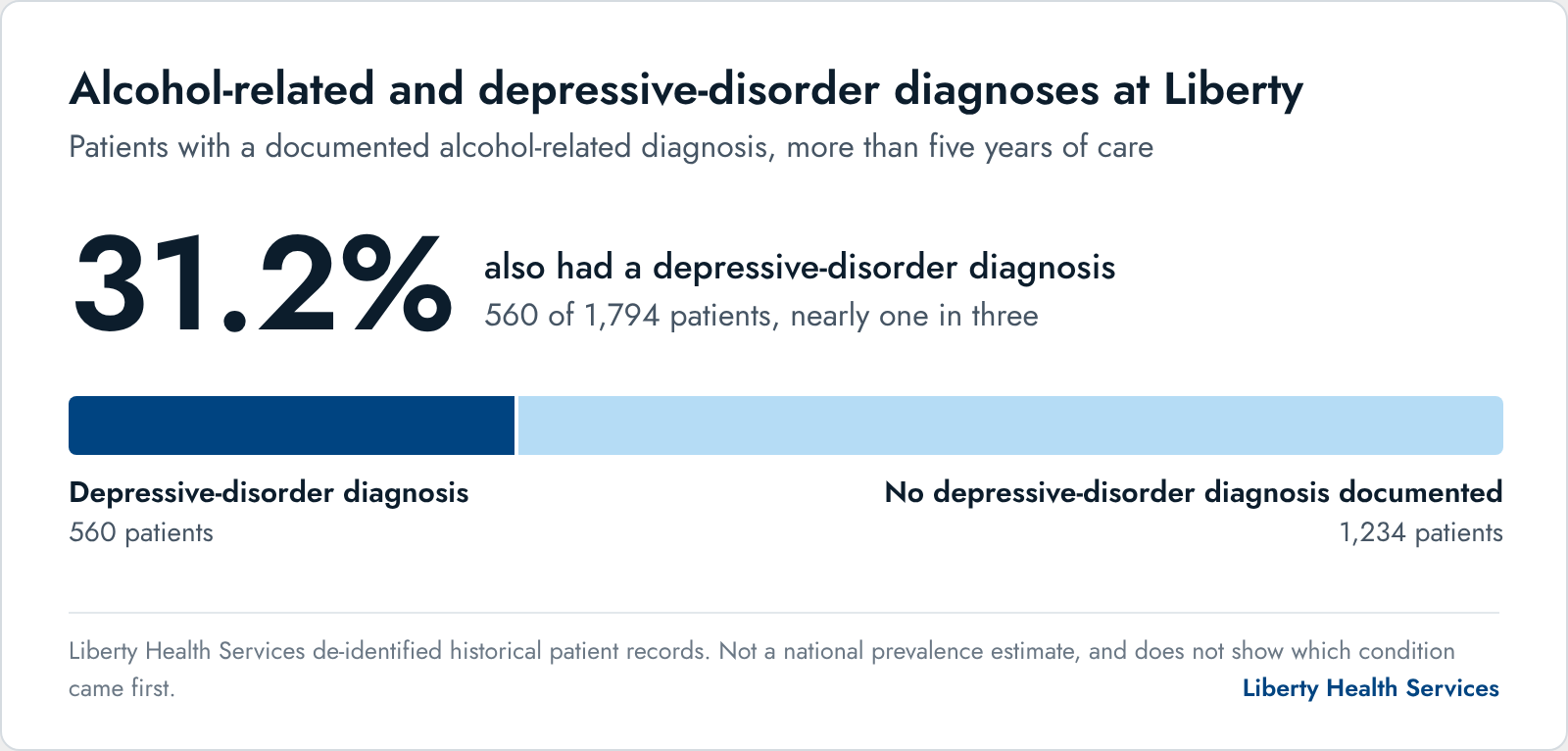
These are Liberty’s historical patient records, not a national prevalence estimate. They cannot establish whether depression began before alcohol use, developed during drinking, or continued after someone stopped.
What they demonstrate is how frequently these conditions were documented together among patients receiving care.
Understanding someone’s mental health is an important part of evaluating their broader treatment needs.
Depressive symptoms may influence daily functioning, motivation, relationships, and recovery. When depression and alcohol use disorder occur together, both conditions deserve attention.
Is the Beck Depression Inventory the Same as an Alcohol Withdrawal Assessment?
No. The Beck Depression Inventory measures depressive symptoms. Alcohol withdrawal assessments serve a different purpose.
For example, the Clinical Institute Withdrawal Assessment for Alcohol, Revised (CIWA-Ar), measures the severity of certain alcohol withdrawal symptoms and may help guide withdrawal monitoring.
The Patient Health Questionnaire-9 (PHQ-9) is another commonly used depression screening tool.
These instruments measure different aspects of a person’s health and are not interchangeable.
The Beck Depression Inventory does not determine whether someone can safely stop drinking without medical supervision.
Alcohol withdrawal can cause serious complications, including seizures and delirium tremens. People who may be physically dependent on alcohol should seek medical guidance before abruptly stopping.
Learn more about medical alcohol detox in New Hampshire.
What Happens If Someone Has a High Beck Depression Inventory Score?
A high BDI-II score indicates significant reported depressive symptoms and warrants appropriate clinical consideration.
A clinician may evaluate the person’s psychiatric history, current functioning, alcohol use, physical symptoms, and safety.
The total score alone cannot determine a diagnosis or treatment plan.
Importantly, suicidal thoughts or wishes require prompt assessment regardless of the overall BDI-II score. A person does not need to score within the severe range to be experiencing a serious mental health concern.
Anyone experiencing suicidal thoughts can call or text 988 to reach the Suicide & Crisis Lifeline. In an immediate life-threatening emergency, call 911.
Frequently Asked Questions About the Beck Depression Inventory and Alcohol Use
What does a Beck Depression Inventory score of 20 mean?
A score of 20 on the BDI-II falls within the moderate depressive symptom range. It indicates reported symptoms that warrant clinical consideration but does not independently diagnose major depressive disorder.
Can alcohol withdrawal cause a high BDI-II score?
Yes. Alcohol withdrawal can contribute to symptoms such as insomnia, fatigue, irritability, and difficulty concentrating. These symptoms overlap with items measured by the BDI-II and can complicate interpretation.
How long after stopping drinking should someone take the Beck Depression Inventory?
There is no mandatory waiting period. Depression screening may be appropriate during withdrawal when a person can participate reliably. Reassessment after stabilization, including around three to four weeks of abstinence, may provide additional information about persistent symptoms.
Does a high BDI-II score mean someone has depression?
A high score indicates significant depressive symptoms but does not independently confirm a depressive disorder. Diagnosis requires a clinical evaluation.
Can BDI-II scores decrease after someone stops drinking?
Yes. Research has found that depressive symptom scores can decrease during the first days and weeks of alcohol abstinence. However, improvement varies, and some people continue to experience depression that requires further evaluation or treatment.
Can someone take the Beck Depression Inventory online?
The official BDI-II is a copyrighted assessment published by Pearson. People seeking a valid assessment should use an authorized version through an appropriately qualified professional rather than relying on unverified online questionnaires.
Is the Beck Depression Inventory the same as the Beck Depression Scale?
The term “Beck Depression Scale” is sometimes used informally to describe the Beck Depression Inventory. BDI-II refers specifically to the second edition of the assessment.
Understanding Depression During Alcohol Recovery
A depression score is useful, but it doesn’t explain everything a person may be experiencing.
Someone who recently stopped drinking may report significant problems with sleep, energy, appetite, concentration, and mood. Several weeks later, some symptoms may have improved while others remain.
That doesn’t make the initial assessment inaccurate. It means the person’s symptoms—and potentially the factors contributing to them—have changed.
The Beck Depression Inventory can help measure those changes, but determining whether someone has an independent depressive disorder requires more than a single score.
At Liberty Health Services in Derry, New Hampshire, we provide medically supervised alcohol detox and residential addiction treatment. If alcohol use has become difficult to manage, our admissions team can help explain the treatment options available.
Learn more about our alcohol detox program in New Hampshire or call 855-959-4521.